Iraq’s Government formation enters high-risk phase under US economic pressure


Shafaq News
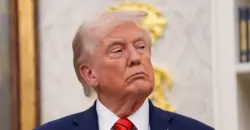
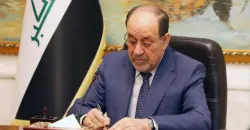
US President Donald Trump’s blunt rejection of Nouri al-Maliki’s return to Iraq’s premiership has pushed government formation into its most precarious phase, transforming what Iraqi factions describe as a constitutional choice into a confrontation shaped by money, leverage, and regional alignment.
The signal from Washington was unambiguous: an al-Maliki-led government would be read not as continuity but as defiance, at a moment when the United States is recalibrating its Middle East posture and narrowing its tolerance for Iranian-aligned power centers inside fragile states.
For Iraq’s Shiite Coordination Framework —the largest parliamentary bloc to which al-Maliki’s State of Law Coalition belongs— the response has been defiant in tone but uncertain in substance. Leaders insist that the premiership is a sovereign Iraqi decision. In practice, however, sovereignty is colliding with a constraint Iraq cannot escape: its economic lifelines remain exposed to US pressure.
Trump’s objection is not rooted solely in al-Maliki’s political past. It reflects a strategic judgment in Washington that Iraq’s next government will either dilute Iran’s grip on the state or formalize it.
Haytham al-Heeti, professor of political science at the University of Exeter, said Washington no longer views Nouri al-Maliki as simply a former prime minister returning to office. “He represents a governing architecture, one that shields Iran-aligned armed groups and embeds their influence within state institutions..”
Previous attempts to reassure US officials were seen, he said, as tactical delays rather than structural change. “This time, the calculation is different,” al-Hiti added. “Washington is no longer managing a balance. It is drawing lines.”
The approach, he argued, has shifted from containment to disruption.
Read more: Nouri Al-Maliki: A name that still divides and tests the politics of memory
Political analyst Omar al-Nasser situates Trump’s stance within a broader realignment of global power, where economics and energy security increasingly dictate political tolerance.
Speaking to Shafaq News, al-Nasser said the aftermath of the Israel–Iran confrontation last June, combined with energy competition and great-power friction, has narrowed Washington’s patience for ambiguous partners. In this environment, “Iraq is no longer a buffer. It is a test case.”
“Trump approaches the region as a marketplace of risk,” al-Nasser said. “Actors are evaluated by cost, not sentiment.”
From that perspective, al-Maliki’s return clashes with a US strategy that prioritizes predictability for markets and leverage over adversaries. Al-Nasser placed responsibility squarely on Iraq’s political class, arguing that its failure to establish firm standards for leadership selection has left the country vulnerable to external vetoes applied through economic pressure.
The tools available to Washington are not theoretical, because Iraq’s financial system remains deeply tied to US-regulated dollar channels, correspondent banking oversight, and oil-revenue mechanisms that pass through international institutions aligned with American compliance standards.
Analyst Ahmed Yousif said Trump’s public stance stripped political cover from those pushing al-Maliki toward a third term. “The problem is not just American opposition,” Yousif told Shafaq News. “It is that al-Maliki carries a record Washington is prepared to weaponize.”
That record —his 2006–2014 tenure— is associated in US policy circles with sectarian polarization, security collapse, and institutional erosion. Combined with his proximity to Tehran, it has turned his candidacy into a pressure point Washington appears willing to exploit.
“These are not abstract threats; they are tools already built into Iraq’s economic structure,” Yousif said.
Within the Shiite Coordination Framework, Trump’s position has sharpened internal strains. Badr Organization MP Mukhtar al-Moussawi acknowledged that al-Maliki’s name has become a liability, not only abroad but at home as well, linking the US objections to corruption, political division, and the cost of reopening old battles.
He argued that realism —rather than concession— requires reassessing a candidacy that risks isolating Iraq at a moment of maximum economic and diplomatic exposure. “The strongest position is avoiding an unnecessary confrontation.”
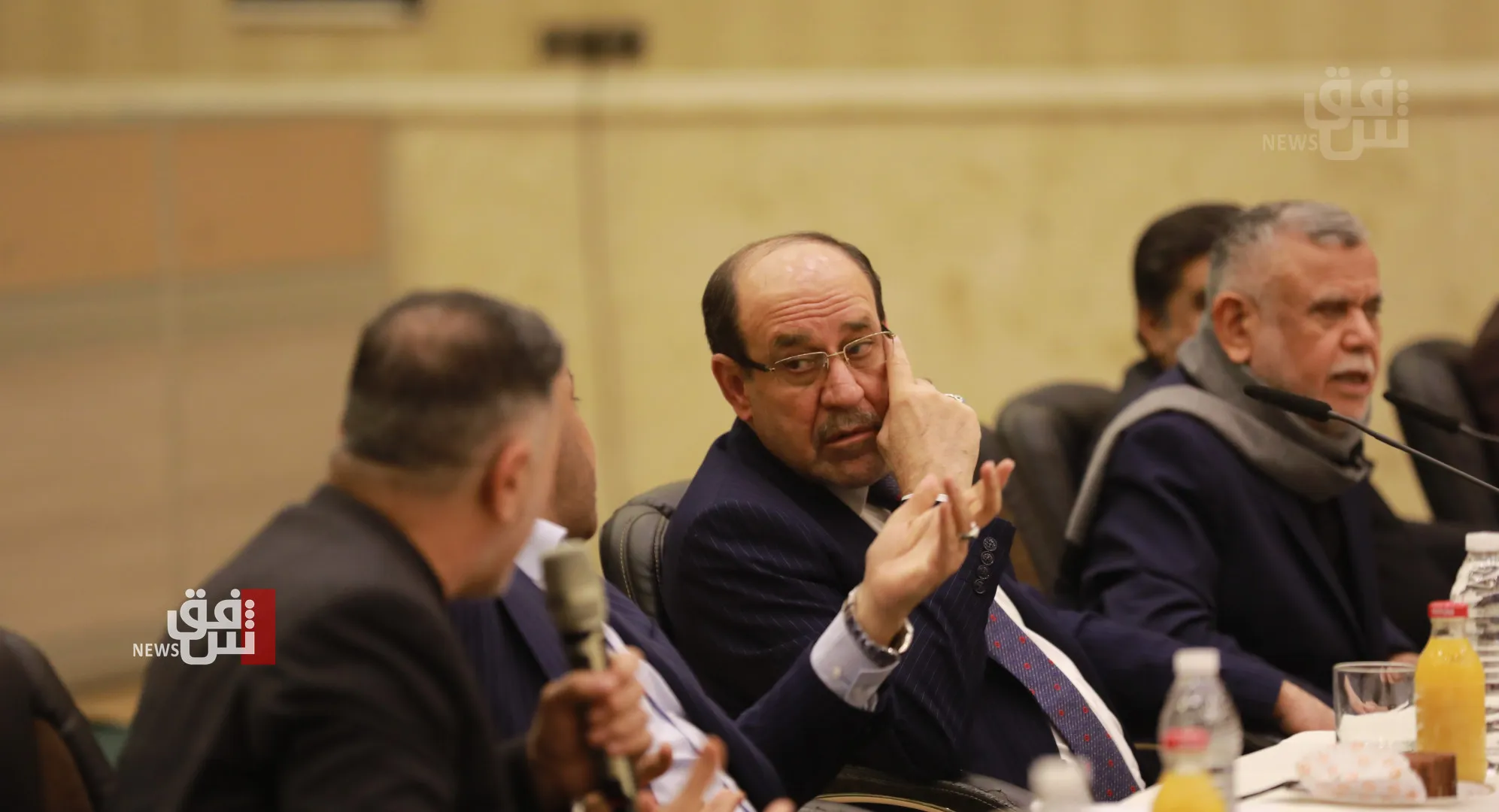
Attention has shifted to the outcome of the emergency Coordination Framework meeting held on Wednesday, which exposed a substantive rift over both leadership and strategy.
Sources told Shafaq News that discussions revealed two competing parties: one pressing to reaffirm al-Maliki’s candidacy as a matter of authority and resistance to pressure, and another warning that insisting on his nomination risks pushing Iraq into a confrontation it is poorly positioned to absorb.
The divide, according to the sources, is not limited to personalities but centers on risk assessment. One camp fears financial and political repercussions Iraq can ill afford. The other rejects any adjustment as capitulation, insisting that retreat under external pressure would weaken the bloc and set a precedent for future interference.
Amid all of this, endorsing al-Maliki would harden US pressure and test Iraq’s financial resilience. Abandoning him would deepen fractures within the Shiite political house and signal vulnerability.
Either way, the decision will define more than a premiership.
Read more: Nouri Al-Maliki’s return rekindles Iraq’s divisions as Iran and the US pull apart
Written and edited by Shafaq News staff.