Exclusive: PJAK leader sets political terms for laying down arms


Shafaq News
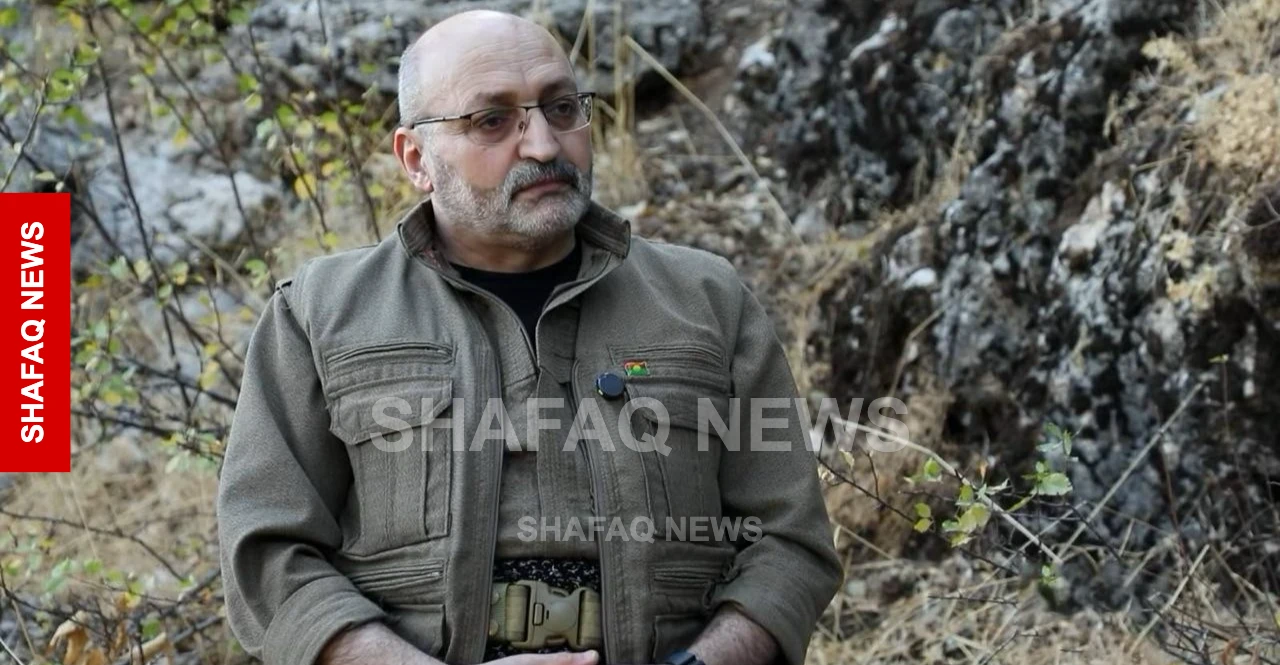
The co-leader of the Iranian Kurdish opposition Party of Free Life of Kurdistan (PJAK), Amir Karimi, has set no date for his party to give up its weapons, but said they would fall silent once Kurds in Iran can pursue their demands through democratic politics and the law, within “a decentralized, democratic and federal Iran free of ethnic or religious domination.”
In an exclusive interview with Shafaq News in Erbil, Karimi discussed Iran's future if the Islamic Republic falls, the party's ties with foreign powers, the prospect of a new military confrontation, and its relations with Baghdad and Erbil. He insisted the party is independent and denied receiving support from the United States or any other foreign power, while saying it has the right to diplomatic relations with any party.
His remarks come at a sensitive time for Iranian Kurdish opposition groups, which face two parallel challenges: securing a place in any change of power in Tehran, and mounting security pressure on their headquarters in the Kurdistan Region of Iraq, where their sites have come under repeated missile and drone attacks in recent months.
A Federal Iran
Karimi does not envision simply rebuilding a centralized state under different leadership. "Our project for the Iran of the future is to establish a decentralized democratic Republic of Iran," he said, with power distributed through a federal system based on the will of the population and direct democracy in local government.
He framed the project as a matter of self-determination, a principle he said the parties in the coalition of Iranian Kurdish groups had adopted unanimously.
Asked whether that right could ultimately lead to independence, Karimi did not rule out secession outright, but said the party was ready to accept a united Iran if national identity were redefined and the rights of its peoples guaranteed in a new constitution.
"Iranian identity needs to be redefined so that all identities can find themselves in it," he said, adding that the legitimacy of any future state would depend on the free participation of its communities and guarantees of self-government, women's rights, and freedom of organization and expression, without ethnic or religious discrimination. “An Iran that meets those conditions will be a common homeland for all the diversity within Iran's geography.”
The vision is not limited to Kurds, Karimi said, but extends to Arabs, Baluch, Azeris and Iran's other ethnic and religious communities, each sharing in running the country while keeping the right to govern itself. The Kurdish issue, in his view, is less an ethnic conflict than the result of an absence of democracy and the dominance of a centralized nation-state, and solving it depends on changing the nature of Iran's political system.
Read more: Baghdad, Tehran step up coordination on Iranian armed groups in Kurdistan
Weapons As Self-Defense
The future of PJAK's armed wing has drawn new attention since the Kurdistan Workers' Party (PKK), with which it has historically shared ideological and organizational ties, announced in May 2025 that it was dissolving and ending its armed struggle against Turkiye. Karimi rejected any automatic link. "The PKK makes its own decisions, and PJAK's decisions are made by our leadership," he said, stressing that his party does not adopt armed struggle as a strategy for national liberation in the manner of 20th-century movements.
The Kurdish cause in Iran is political at its core and needs a political settlement, Karimi said, but Iranian authorities treat Kurdish demands as a security and military matter, which he said makes self-defense necessary in the face of repression.
"For us, weapons are not a strategy but a means of self-defense," he said. “The real problem is not that Kurds carry arms, but the absence of political and legal channels to address their demands.”
"Whenever democratic politics and the law become the main mechanism for resolving our people's cause, the weapons will fall silent and will no longer be needed," Karimi said, without offering a timetable or specific mechanism for moving from armed activity to politics.
Read more: Iranian Kurdish opposition rejects disarmament in Iraq
Washington And Israel
Karimi denied that his party had received aid or support from any party, including the United States. "We have the right to have diplomatic dealings with any power or party," he said, but drew a line between political relations and dependence on outside powers. "We are an independent movement, and we maintain that independence."
Any foreign relations, he said, must be measured against the rights and interests of the Kurdish people and the future of democracy in Iran.
Asked about possible contacts with Israel, Karimi did not say directly whether any channels exist, stressing only the party's right to deal diplomatically with various parties out of “political realism rather than ideology.”
He also declined to commit in advance to joining any new war between Iran and the United States or Israel. PJAK is present and active inside Iran and is not waiting for any foreign power to open the way, he said. "We don't need anyone to make room for us. We create our own opportunity." The party will act "wherever and whenever it is needed for freedom and to protect the existence of the people," he added, describing its fight as "a war that is ours and for us."
Testing Kurdish Unity
In February 2026, five Iranian Kurdish parties announced the Coalition of Political Forces of Iranian Kurdistan: PJAK, the Democratic Party of Iranian Kurdistan (KDPI), the Kurdistan Freedom Party (PAK), the Khabat Organization of Iranian Kurdistan, and the Kurdistan Toilers Association (Komala)
Karimi described the coalition as the product of a shared reading of opportunities and risks but said that was not enough to hold it together. "We should not unite only based on shared opportunities or risks," he said, calling for a solid political program and deep dialogue on the parties' roles and strategy. “Their ideological and political differences should remain but serve as grounds for dialogue rather than exclusion. “
He called the coalition "a special experience and a training ground for democracy" that he hopes could serve as a model for Iran after any political transition.
Baghdad and Erbil
The presence of Iranian Kurdish opposition groups in the Kurdistan Region has long been a sensitive issue between Baghdad and Tehran. In March 2023, Iraq and Iran signed a security agreement on border control and preventing Iraqi territory from being used for attacks on neighboring countries. In September that year, Baghdad said it had moved the groups away from the border, ahead of treating their members as civilians. Tehran has continued to demand that they be disarmed, and a joint high-level security committee discussed the issue again in May 2026.
Several headquarters of Iranian Kurdish parties in Erbil and Al-Sulaymaniyah have been attacked this year, and Iran's Islamic Revolutionary Guard Corps (IRGC) has claimed some of the strikes. Political sources told Shafaq News on Wednesday that Iraqi leaders are discussing a proposal to move the groups out of the Kurdistan Region to a center elsewhere in Iraq, with Al-Muthanna province in the south among the options.
Karimi said that his party has never used Iraqi territory for operations against Iran and has had no disputes with either Iraqi authority. "Over 22 years of our struggle, we have had no problem with either the Kurdistan Regional Government or the Iraqi government," he said, adding that the party's forces and members are based and active inside Iran. "We have never used Iraqi territory for activities against the Islamic Republic."
Read more: Iraqi–Iranian Security MoU rekindles a decade of border deals—and old controversies
After the Islamic Republic
Toppling the Islamic Republic of Iran alone is not enough, Karimi warned, if the rules of governance are not rewritten, as a new government could reproduce political and ethnic domination in a different form. "No group or identity should be allowed to impose its dominance for any reason," he said, calling for public and local administration to rest on councils and institutions so that no individual or group can monopolize power.
He also rejected what he called a "dictatorship of the majority," calling for constitutional and legal guarantees to protect minorities even under a democratic electoral system. In such a system, he said, his party would see itself as part of the political process "whatever the election results."
Karimi acknowledged that his party also fears that rivalry between ethnic groups and armed parties could turn into a new conflict if the Islamic Republic's institutions collapse. “Iran's ethnic and religious diversity is a source of richness, but could become a source of conflict if combined with extreme nationalism, religious extremism and a weak culture of dialogue, especially if foreign powers exploit the divisions.”
For that reason, he urged that a new social contract be negotiated before any transfer of power rather than after the fall of the government, pointing to his party's role in the Free Congress for Iran, a front with pro-democracy Iranian forces that “allows such disputed questions to be discussed.”
Founded in 2004, PJAK is one of the main Iranian Kurdish groups opposed to Tehran. It follows the doctrine of "democratic confederalism" developed by PKK founder Abdullah Ocalan, and its armed wing has fought intermittent clashes with Iranian forces, particularly the Revolutionary Guards, from bases historically in the Qandil mountains on the Iraq-Iran border. Tehran accuses it of armed activity against the state, and the US Treasury designated PJAK in 2009 under
Read more: Interior Minister: Attacks target KRI from all sides