A decade of isolation: Why Europe still bars Iraq's "Green Bird"


Shafaq News
When the European Union banned Iraqi Airways in 2015, citing “serious safety concerns” and a failure to meet international aviation standards, the decision went far beyond a bureaucratic restriction. For Iraq, it symbolized the loss of access to one of the world’s most important air corridors — and a blow to national prestige that still lingers a decade later.
Despite repeated assurances and costly reform plans, Baghdad has yet to convince European regulators that its skies are safe. The ban remains in place, a reminder of the gap between ambition and implementation in Iraq’s aviation sector.
According to Meitham al-Safi, spokesman for the Ministry of Transport, the government continues to push for the removal of the ban through a specialized committee working in conjunction with the International Air Transport Association (IATA). The focus is on securing two crucial certifications — the IATA Operational Safety Audit (IOSA) and the Third Country Operator (TCO) authorization — which are mandatory for European operations.
“Lifting the ban depends on two main tracks,” al-Safi explained. “The first is correcting the shortcomings identified by IOSA, and the second is obtaining the TCO certificate.”
Behind these technical terms lies a broader effort to rebuild Iraq’s aviation system from within. Iraqi Airways, the country’s national carrier, has rolled out a comprehensive Safety Management System (SMS), enhanced aircraft performance monitoring, and revised its operational manuals to align with ICAO requirements.
The airline is also in the final stage of adopting an electronic flight bag system for its pilots — a digital tool that most advanced airlines already consider standard.
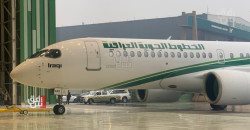
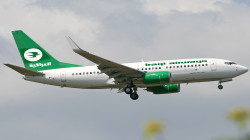
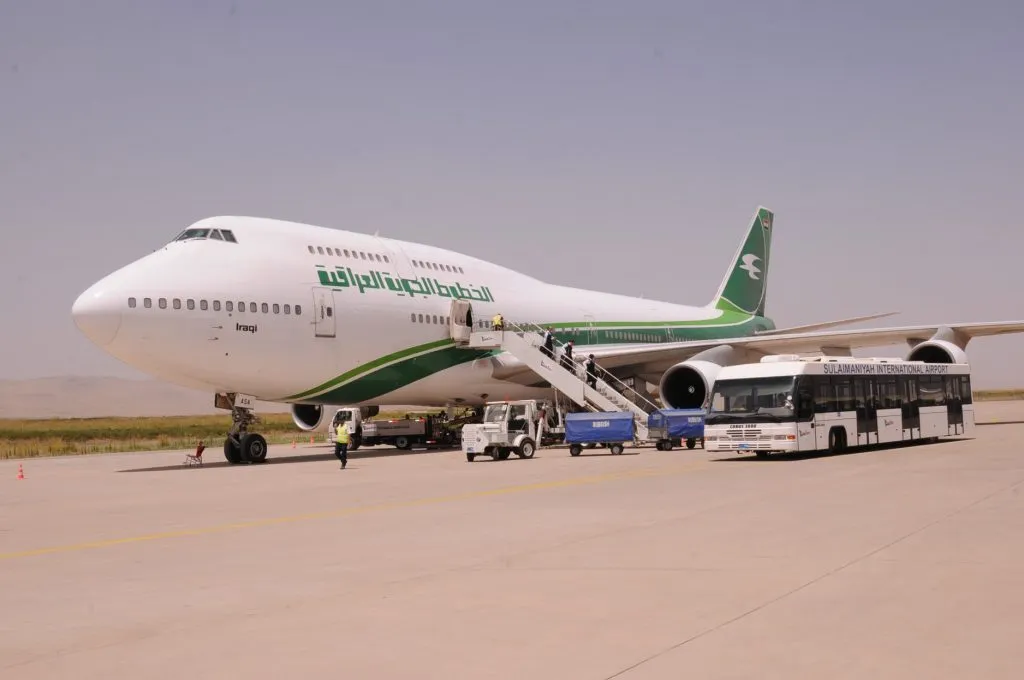
The “Green Bird,” as Iraqis affectionately call their airline, has taken visible steps toward modernization: contracting foreign companies for ground and cargo services, upgrading maintenance software, and improving quality assurance systems.
According to al-Safi, nearly 79% of IOSA’s corrective program has already been completed — a milestone that will allow the European Union Aviation Safety Agency (EASA) to begin reviewing the case for lifting the ban.
To accelerate the process, the company has enlisted IATA consultants and international service providers, aiming to bridge the gap between Iraq’s aviation infrastructure and European expectations.
Stuck on Ground
Despite the visible reforms, Brussels remains unconvinced. In June 2025, the European Union extended the ban for another six months, citing persistent gaps in safety oversight, regulatory enforcement, and infrastructure standards.
A 2024 ICAO audit placed Iraq among the lowest in the Middle East for “effective implementation” of aviation safety protocols, with a score below 55%, compared to a regional average exceeding 70%. In 2025, the World Bank also ranked Iraq’s airport infrastructure among the least developed in the region, behind Jordan, Saudi Arabia, and the United Arab Emirates.
Experts argue that the challenge is not just technical but institutional, as Iraq’s Civil Aviation Authority still suffers from limited capacity, inconsistent oversight, and insufficient training programs for engineers and flight safety personnel. The process of reform, they note, has been slow — hampered by bureaucratic inertia and decades of underinvestment.
According to al-Safi, Iraq has nevertheless made strides in safety management, quality assurance, and operational monitoring. Yet for the European Union Aviation Safety Agency (EASA), words and partial reforms are not enough. The agency’s criteria are stringent, and its audits exhaustive — any inconsistency in documentation, pilot training, or maintenance procedures can delay the process for months.
The result is that Iraq’s national carrier remains excluded from European skies, forcing passengers to connect through Istanbul, Doha, or Dubai. The extra hours and higher costs have made travel between Iraq and Europe a logistical burden for millions.
Read more: Flights suspension to Iraq: Preventive action or signs of impending threats?
Isolation's Heavy Cost
For the estimated four to five million Iraqis living abroad, the ban has turned air travel into an expensive and exhausting ordeal. Aviation expert Nameer al-Qaisi estimated that Iraq loses between $2 and $3 billion annually in indirect costs, given that an average ticket from Europe to Iraq costs around $500.
“The absence of direct sovereign routes with major capitals such as London, Paris, and New York deprives Iraq of economic opportunity and prestige,” al-Qaisi remarked. “A fully operational fleet, modernized and internationally certified, could turn losses into profits and project confidence in Iraq’s recovery.”
The Transport Ministry reported revenues of 724 billion dinars (approximately $550 million) in 2024, but officials believe reopening the European corridor could dramatically increase this figure.
Beyond economics, the ban carries a human cost. Hussam al-Nasiri, an Iraqi living in Sweden, described the strain of long layovers and high expenses. “A direct flight between Baghdad and Stockholm would take about 11 hours,” he recounted. “But with transits, the journey stretches far longer, adding fatigue and extra costs for meals and necessities.”
For Sarmad al-Taie, an Iraqi in the Netherlands, the inconvenience has altered family life. “I used to visit my relatives in Baghdad once a year,” he reflected, “but now I travel only once every three years.”
Others have faced physical hardship. Zaman Ali recounted accompanying her elderly father on a medical trip to London. “He suffered severe pain during the long layover in Dubai,” she recalled. “By the time we returned to Baghdad, his condition had worsened.”
In response, Iraqi Airways has sought to adapt — expanding regional routes, and forming new service partnerships. These steps, officials argue, have turned the crisis into a catalyst for modernization.
Other nations have faced similar ordeals. Both Indonesia and the Philippines, once under European flight bans, eventually regained access after overhauling their aviation frameworks and aligning national standards with ICAO guidelines.
For Iraq, the hope is that such examples may soon become a precedent rather than a comparison — and that the “Green Bird” will one day reclaim its place among the world’s carriers, flying once again over European skies.
Written and edited by Shafaq News staff.