Iraq faces permanent drought risks despite seasonal rainfall


Shafaq News- Baghdad
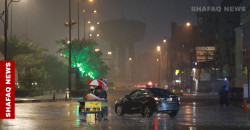
Iraq’s recent rainy season lifted water levels in dams and reservoirs, offering short-term relief in parts of the country. The gains, however, have not shifted longer-term concerns, as declining water resources, desertification and dust storms continue to define the broader environmental outlook.
Speaking to Shafaq News, Torhan al-Mufti, adviser to the prime minister for water affairs, described the rainy season as strong compared with previous years. Still, he argued that the underlying water crisis remains unchanged despite seasonal gains, pointing to climate change and inefficient water use as the main pressures on supply.
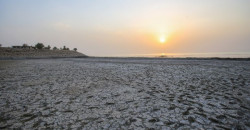
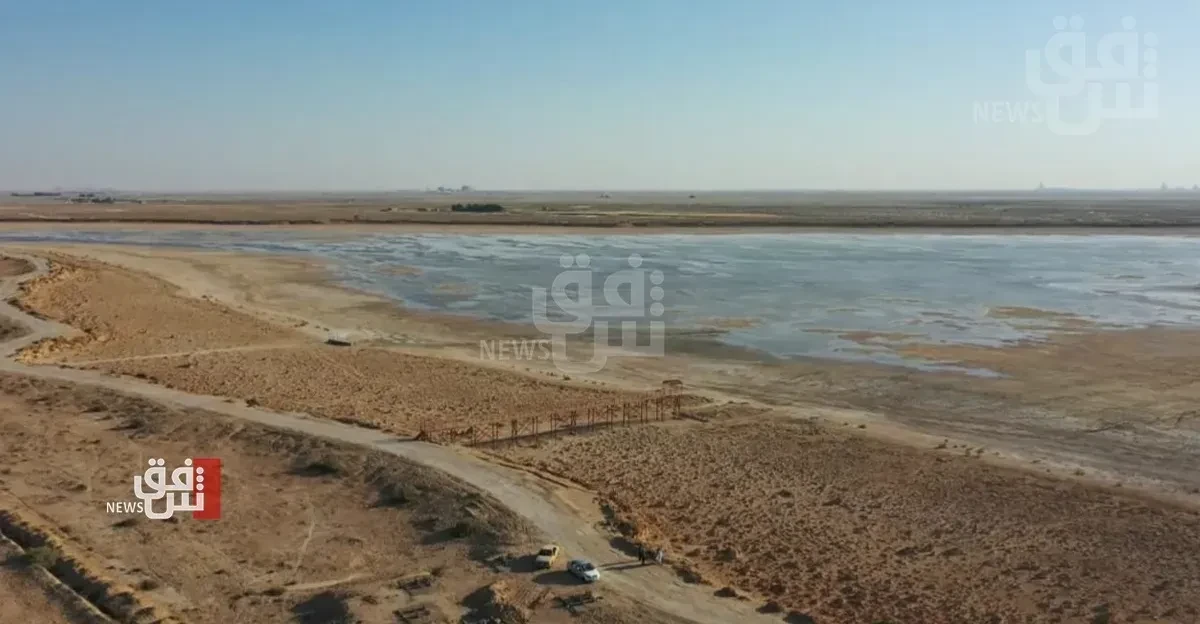
In the south, Sawa Lake in al-Muthanna province has largely dried up after years of declining rainfall and intensive groundwater extraction. According to Amir Kadhim al-Aradi, head of the Environment Department in the province, the decline is linked to widespread well drilling and rising demand for water in agriculture and industry, including cement and brick production.
Stressing that the underground aquifers feeding the lake have been depleted, he noted that the Ramsar-listed wetland has lost most of its ecological activity while its biodiversity was sharply reduced.
Similarly in Najaf, climate-related displacement has increased as water shortages and land degradation deepen. In an interview with our agency, Haider Faleh Hassan, head of the province’s Climate Change Division, linked rising desertification to reduced Euphrates flows and stagnant water conditions.
Read more: Floods vs. deficit: Did rain solve Iraq’s water problem?
The province has received 742 families from al-Diwaniyah, al-Muthanna, and Dhi Qar as agricultural livelihoods weaken under mounting water stress. Some nomadic groups have also moved toward less arid areas in search of grazing land.
According to the Iraqi Ministry of Agriculture, Najaf has about 449,000 dunams of agricultural land, while more than 10 million dunams across the country are now exposed to desertification risk. Large areas have also been affected by salinity and waterlogging, with additional land taken out of cultivation in 2025.
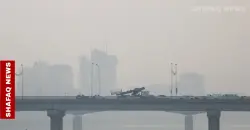
In its latest report, the Iraq Green Observatory also estimated that more than 60% of the country is affected by desertification, with dust and sandstorms expected to exceed 100 days annually, driven by both domestic conditions and incoming dust from Syria, Saudi Arabia, and the Badia region.
Read more: Iraq burns: Dust, drought ravage the nation's core
The UN Food and Agriculture Organization (FAO) reported that forested areas in Iraq now cover only 8,250 square kilometres, around 2% of the country’s total territory. Its 2025 study indicated that 90% of Iraq lies within arid and semi-arid climate zones, where summer temperatures frequently exceed 50°C, while rainfall has declined between 5–15 cm.
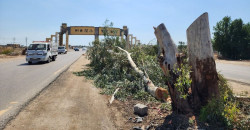
Even as conditions deteriorate, local initiatives have emerged to slow environmental decline. In Najaf, afforestation campaigns have planted more than 6,000 seedlings over the past month.
Haider al-Saffar, head of afforestation and nurseries at the Najaf Agriculture Directorate, explained that the projects focus on plant species capable of withstanding high salinity and water scarcity while avoiding damage to infrastructure. He added that selected tree varieties are chosen based on scientific studies and agricultural expertise, with an emphasis on improving ventilation, reducing humidity, and lowering temperatures.
Citing that the plan integrates modern irrigation systems and green corridors to create ecological pathways aimed at restoring environmental balance, he noted that the long-term goal targets a reduction of up to seven degrees Celsius in urban temperatures by 2030, further positioning Najaf as a national model for environmental planning.
In Karbala, the Fadak Date Palm Farm, one of Iraq’s key agricultural sustainability projects, operates in affiliation with the Imam Hussein Shrine. Farm director Faiz Abu al-Maali told Shafaq News that the project, located west of Karbala near Lake Razzaza, has planted more than 30,000 palm trees as part of efforts to reclaim desert land and expand green cover.
“The farm relies on drip irrigation and organic farming methods to reduce water consumption and maintain soil quality,” he added, noting that it also maintains a genetic bank of more than 90 varieties of Iraqi and Arab date palms, aimed at preserving agricultural heritage and strengthening food security.