Babil unearths 2,000-year-old hymn on morality and women


Shafaq News – Babil
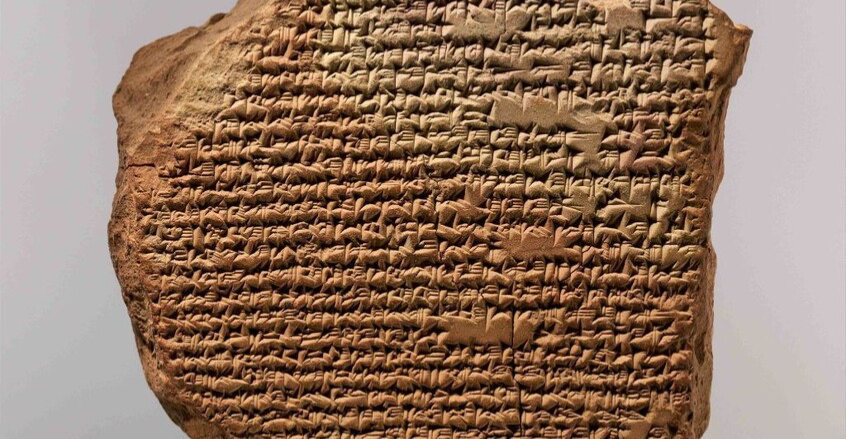
A German research team in Babil has discovered parts of an ancient hymn carved into clay tablets in the ruins of the city of Sippar, about 65 kilometers north of the province.
The religious poem, dedicated to the god Marduk, protector of Babylon, dates back more than 2,100 years to the ancient Babylonian civilization and offers poetic descriptions of life in the city, including its flowing rivers, jewel-adorned gates, and pure priests.
Researchers from Ludwig Maximilian University in Munich used artificial intelligence to reconstruct 30 scattered tablet fragments, a process that would have taken decades using traditional methods.
The original hymn is composed of approximately 250 lines, of which scholars have so far deciphered and translated about one-third of the cuneiform text.
Professor Enrique Jimenez, who led the team, described the text as possessing exceptional literary quality and precise structure.
The hymn begins with praise for Marduk, calling him the “architect of the universe,” and continues with praise for Babylon, portraying it as a paradise rich in blessings.
It also includes a vivid depiction of the Euphrates River and the fertile plains around it, where livestock graze. Revealing moral values in Babylonian society, the text highlights respect for strangers and protection of the weak.
The hymn praises priests who treat foreigners with respect, free captives, and care for orphans. It also mentions female priests serving as midwives—a role not previously documented in other historical sources.
It is believed to have held a special status in Babylonian culture and remained part of the school curriculum for nearly a thousand years, from the 15th century BCE (Before Common Era) to the 1st century BCE.
Among the lines in the hymn is a poetic passage describing the Euphrates River:
"The Euphrates is her river,
the work of the wise god Nudimmud,
It waters the banks, irrigates the plains, Pours its waters into the lake and the sea,
Its fields bloom with herbs and barley,
Spring grass and grain shine in its meadows,
Mounds of beer grains pile in its center,
Cattle and sheep rest on green pastures,
Abundance and wealth—what is rightful for the people?
Multiply, are available, and pour forth in plenty."
The hymn is estimated to have been written between 1500 and 1300 BCE, making it one of the oldest long literary works in Babylon’s history.
Although more recent than the Epic of Gilgamesh, the hymn was studied and copied alongside it for centuries. Researchers believe it was the work of a single author, though his identity remains unknown.
Hymn of Babylon pieced together after 2,100 years — but how?A lost classic of Mesopotamian literature has largely been reconstructed by scholars, who recovered fragments of 30 ancient clay tablets https://t.co/ai49fCW6VJ
— Times Culture (@timesculture) July 2, 2025