
Podcast Icon Podcasts
Can Starbucks regain its buzz?

Can Starbucks regain its buzz?

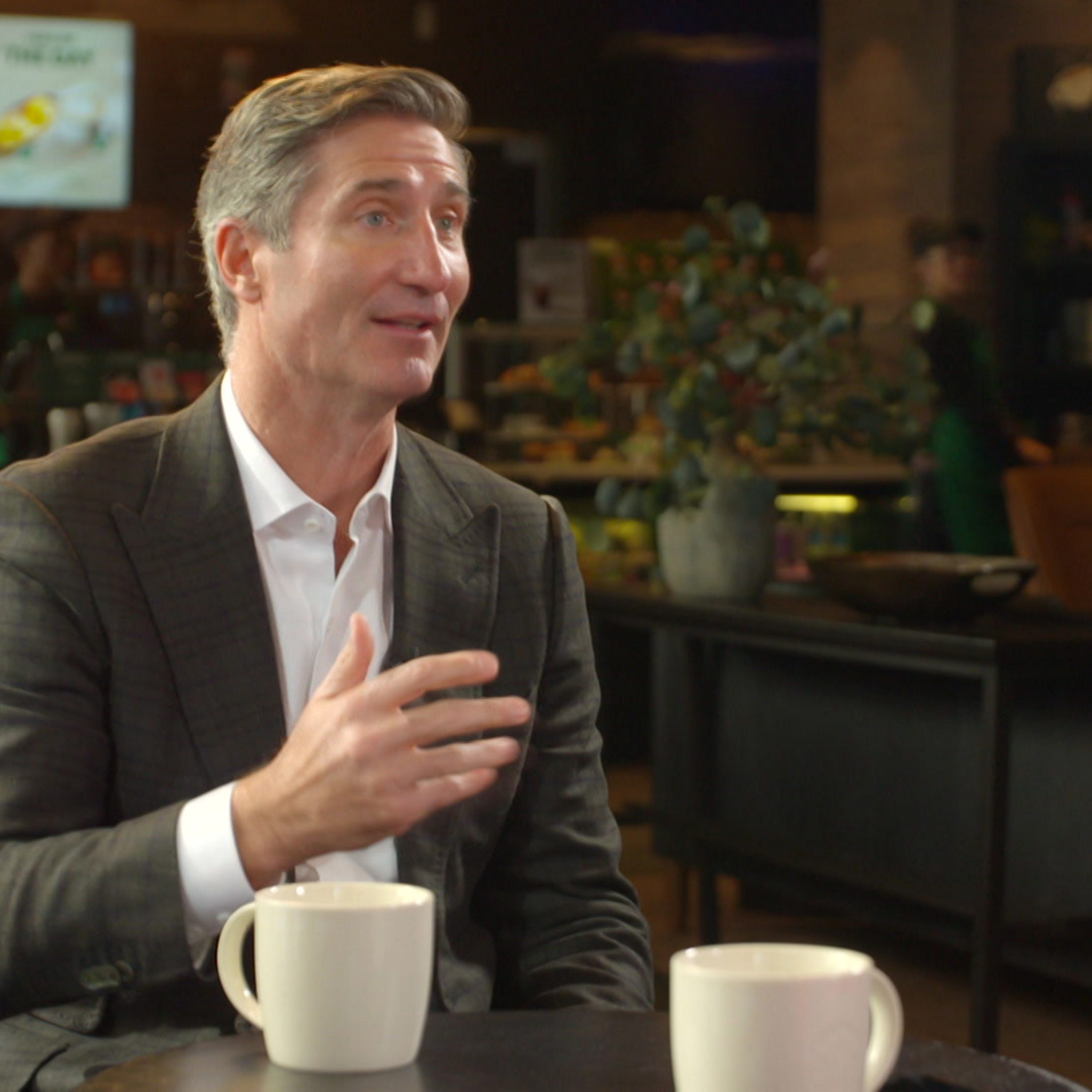
It’s probably the world’s best-known coffee chain but just over a year ago, business wasn’t doing well. Sales had slipped, customers were drifting away and the buzz had gone.

Newly-arrived CEO Brian Niccol was handed a tough task: stop the fall and make the coffee shops somewhere people wanted to return to.

In an interview with our North America business correspondent Michelle Fleury, he explains why customers are returning and seem to be giving the company another shot.

If you'd like to get in touch with the team, our email address is [email protected]

Producers: John Mervin and Justin Bones

Business Daily is the home of in-depth audio journalism devoted to the world of money and work. From small startup stories to big corporate takeovers, global economic shifts to trends in technology, we look at the key figures, ideas and events shaping business.

Each episode is a 17-minute deep dive into a single topic, featuring expert analysis and the people at the heart of the story.

Recent episodes explore the weight-loss drug revolution, the growth in AI, the cost of living, why bond markets are so powerful, China's property bubble, and Gen Z's experience of the current job market.

We also feature in-depth interviews with company founders and some of the world's most prominent CEOs. These include the CEO of Google Sundar Pichai, Wikipedia founder Jimmy Wales, and billionaire founder Judy Faulkner of Epic Systems, one of the world's largest medical record software providers.

(Picture: Brian Niccol, CEO of Starbucks, sitting in one of the company's coffee shops in downtown New York.)


The man who built Africa's largest AI firm

The man who built Africa's largest AI firm

From the deserts of Tunisia to the boardrooms of global tech giants, we meet Karim Beguir, the mathematician who turned two laptops and 2000 dollars into Africa’s biggest AI firm.

We hear how his company, Instadeep, caught the attention of Meta’s Mark Zuckerberg, and how it helped to track dangerous new variants in the Covid pandemic using large language models.

If you'd like to get in touch with the team, our email address is [email protected]

Presenter: Ed Butler Producers: Niamh McDermott and Hannah Mullane

Business Daily is the home of in-depth audio journalism devoted to the world of money and work. From small startup stories to big corporate takeovers, global economic shifts to trends in technology, we look at the key figures, ideas and events shaping business.

Each episode is a 17-minute deep dive into a single topic, featuring expert analysis and the people at the heart of the story.

Recent episodes explore the weight-loss drug revolution, the growth in AI, the cost of living, why bond markets are so powerful, China's property bubble, and Gen Z's experience of the current job market.

We also feature in-depth interviews with company founders and some of the world's most prominent CEOs. These include the CEO of Google Sundar Pichai, Wikipedia founder Jimmy Wales, and the billionaire founder of Epic Systems, one of the world's largest medical record software providers, Judy Faulkner.

(Picture: CEO of Instadeep, Karim Beguir, at a photoshoot in Paris in 2024. Credit: Getty Images)

Why you buy what you buy

Why you buy what you buy

We lift the curtain on how everyone from toothpaste brands to the United Nations is using science to influence your choices in ways you’re probably not aware of. Behavioural science has even made its way into TV drama.

How does it work? And why is it so effective?

If you'd like to get in touch with the team, our email address is [email protected]

Presented and produced by Rowan Bridge

Business Daily is the home of in-depth audio journalism devoted to the world of money and work. From small startup stories to big corporate takeovers, global economic shifts to trends in technology, we look at the key figures, ideas and events shaping business.

Each episode is a 17-minute deep dive into a single topic, featuring expert analysis and the people at the heart of the story.

Recent episodes explore the weight-loss drug revolution, the growth in AI, the cost of living, why bond markets are so powerful, China's property bubble, and Gen Z's experience of the current job market.

We also speak to some of the world's most influential business leaders. These interviews include the CEO of Google Sundar Pichai, Wikipedia founder Jimmy Wales, and the billionaire founder of Epic Systems, one of the world's largest medical record software providers, Judy Faulkner.

(Picture: The hand of a woman about to cause a chain reaction by pushing over a domino. Credit: Getty Images)

Copper theft: A growing economic problem

Copper theft: A growing economic problem

Demand has been surging for copper around the world - from renewable energy projects, to AI data centres, to infrastructure networks.

Production, however, has struggled to keep pace, pushing prices close to record highs in late 2025 and early 2026.

As the value of the metal has risen, criminals have increasingly targeted copper for theft - stripping it from telephone cables, railway power lines and solar panels. The resulting damage and disruption is costing economies billions.

If you'd like to get in touch with the team, our email address is [email protected]

Presented and produced by Russell Padmore

Picture: Train passengers look at a train information board at Zwolle station in Zwolle on the first of December 2025 after an extensive track damage caused by an attempted copper theft disrupted train services. Credit: Getty Images)

How country music became cool

How country music became cool

Country music is in the midst of a grand renaissance. The genre - whose popularity was previously confined to the American South - is now climbing the charts, grabbing the attention of Gen Z audiences, and changing the perception of what it means to be a country listener. Streaming of the genre in the US rose by nearly 110% in the five years to 2024. And it’s taking over markets all around the world. In the UK, the genre more than doubled its share of the singles market in two years. And Australia is now the third largest country music market globally. From ‘music city’ - Nashville, Tennessee - we speak to artists and industry leaders to better understand where the country music boom came from, and where it’s headed this year. How did country become so cool?

To get in touch with the team, our email address is [email protected]

Presented and produced by Ellie House

(Picture: Neon lights spelling 'Music City Tonight' at Robert's Honky Tonk, Nashville. Credit: BBC)

How global conflict is changing air travel

How global conflict is changing air travel

One of the world’s largest airline groups has told Business Daily that airspace closures, due to war zones, are now forcing substantial rerouting of flights.

Lufthansa says the ban on using Russian and Ukrainian airspace is having a measurable cost impact on its long haul network, with typical detours of one to two hours.

A recent Conflict Intensity index report shows that areas affected by armed fighting have grown by 89% over the past five years, that is one and a half times the size of the European Union.

We examine the cost to consumers, and the environmental impacts of these changes.

If you'd like to get in touch with the team, our email address is [email protected]

Producer/presenter: Rick Kelsey

(Photo: Planes landing and taking off against a coloured sky. Credit: Getty Images)

Lew Frankfort: Building a billion-dollar brand

Lew Frankfort: Building a billion-dollar brand

When Lew Frankfort joined Coach, it was a family run, wholesale handbag business worth six million dollars.

He spent 35 years at the company, from opening the company's first shop to growing the business now valued at over five billion dollars.

We find out what led Lew to an unlikely career in fashion and how a chance meeting with a US president sparked his social consciousness.

If you'd like to get in touch with the programme, our email address is [email protected]

Presenter: Ed Butler Producers: Hannah Bewley and Hannah Mullane

(Photo: Lew Frankfort, chairman emeritus and former CEO of Coach)

Can an island of flowers become a global chip hub?

Can an island of flowers become a global chip hub?

Forty years ago Japan made more than half of the world's semiconductors. Today, it produces just over 10%. But the country has big ambitions to turn that around.

We hear from the CEO of a company at the centre of the government's high-stakes gamble to revive its semiconductor industry, and more broadly, its tech power.

And we'll learn how the island of Hokkaido is now the site of billions in investment to turn what has long been an agricultural powerhouse into a global chip manufacturing hub.

If you'd like to contact the programme, our email address is [email protected]

Presenter: Suranjana Tewari Producer: Jaltson Akkanath Chummar

(Picture: A lavender field and colourful flower garden in Hokkaido, Japan. Credit: Getty Images)

Slovakia: Small country, auto giant

Slovakia: Small country, auto giant

When Slovakia was part of the Czechoslovak Socialist Republic, the cars it made were noisy, thirsty and slow by western standards at the time. But when Volkswagen bought the car-maker Skoda, that was the beginning of a major change.

Now, Slovakia makes almost a million cars a year and with Volvo opening a factory here in 2027, it’ll be a quarter of a million more. Extraordinary for a country of five million people.

We visit a factory and find out why this small nation is attracting so much car industry investment.

If you'd like to get in touch with the programme, our email address is [email protected]

Presented and produced by John Laurenson

(Picture: Workers on a production line in a car factory, Slovakia. Credit: BBC/John Laurenson)

America's affordability question

America's affordability question

In the second of two programmes, we look at Donald Trump's record on the economy one year into his second presidential term. Today, we are asking is the United States still facing a cost of living crunch?

Its economy - the largest in the world - is still growing faster than most others and the stock markets are hitting record highs, yet many Americans say they are still struggling to make ends meet. What's going on? We get the view from our North America business correspondent, Samira Hussain; a data scientist; an economist; and consumers from across the country.

If you'd like to get in touch with the team, our email address is [email protected]

Presenter: Rahul Tandon Producer: Craig Henderson Additional production (audio diaries): Niamh McDermott

(Picture: A woman walks down the aisle at the grocery store with her shopping cart looking at shelved goods. Credit: Getty Images)

Life after DOGE

Life after DOGE

Twelve months into Donald Trump’s second term as President, we examine what it’s meant for the US workforce.

For government workers it has been a year of cuts, sackings and Elon Musk’s now disbanded DOGE - Department of Government Efficiency - group. Some sections of the workforce have felt their rights under attack. Meanwhile, many Republicans feel DOGE has been a success.

Has the past year also provided opportunities for those switching to the private sector?

If you'd like to get in touch with the programme, our email address is [email protected] Presenter: Ed Butler Producer: Craig Henderson

(Picture: President Donald Trump listens during a Cabinet meeting at the White House on the 26th of February 2025 in Washington, DC. He was holding the first Cabinet meeting of his second term, joined by Tesla and SpaceX CEO Elon Musk, then head of the Department of Government Efficiency (DOGE). Credit: Getty Images)

CEO of the Folio Society, Joanna Reynolds

CEO of the Folio Society, Joanna Reynolds

We meet retail turnaround expert Joanna Reynolds, the woman behind the revival of the Folio Society, one of Britain’s oldest publishing houses.

Ten years ago, the company was losing money and facing an existential threat from the digital revolution.

Joanna explains how she transformed the business from a failing book club to a profitable, employee-owned publisher.

If you'd like to get in touch with Business Daily, our email address is [email protected]

Presenter: Sam Fenwick Producer: David Cann

(Picture: Joanna Reynolds, CEO of the Folio Society, holding a book. Credit: Dunja Opalko)

Shafaq Live
Shafaq Live
Radio radio icon