US: Iran violated ceasefire with Kuwait missile attack



Shafaq News- Middle East
The United States on Thursday accused Iran of violating the 50-day-old ceasefire after Tehran allegedly launched a ballistic missile toward Kuwait amid escalating tensions near the Strait of Hormuz.
US Central Command (CENTCOM) claimed that Kuwaiti forces intercepted the missile late Wednesday, while US forces intercepted five Iranian one-way attack drones operating near the Strait of Hormuz and prevented a sixth drone launch from a ground control site in Bandar Abbas.
At 10:17 p.m. ET on May 27, Iran launched a ballistic missile toward Kuwait that was successfully intercepted by Kuwaiti forces. This egregious ceasefire violation by the Iranian regime occurred hours after Iranian forces launched five one-way attack drones that posed a clear…
— U.S. Central Command (@CENTCOM) May 28, 2026
Kuwait’s Foreign Ministry “strongly condemned” the attacks as a “dangerous escalation” and a “flagrant violation” of Kuwaiti sovereignty and territorial integrity that threatened civilians and vital infrastructure, demanding that Iran immediately halt the attacks and warning that Kuwait reserved the right to take “all necessary measures” to defend its territory and strategic facilities under international law.
بيان صادر عن وزارة الخارجيةالخميس 28 مايو 2026تعرب وزارة الخارجية عن إدانة واستنكار دولة الكويت الشديدين للاعتداءات الإيرانية الآثمة التي استهدفت أراضي دولة الكويت بالصواريخ والطائرات المسيرة، في تصعيد خطير وانتهاك صارخ لسيادة دولة الكويت وأمنها وسلامة أراضيها، وتهديد مباشر… pic.twitter.com/ADFojQZKBc
— وزارة الخارجية (@MOFAKuwait) May 28, 2026
Iran’s Islamic Revolutionary Guard Corps (IRGC) Navy, meanwhile, disputed the US account, saying American forces had fired missiles toward “empty areas” near Bandar Abbas airport before the incident and that “the US base from which the aggression originated came under counterattack.”
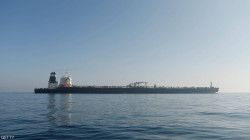
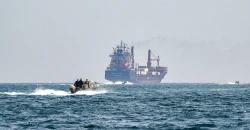
Any further disruption in the Strait of Hormuz would face a “decisive response,” the IRGC Navy added, stressing that control and administration of the strategic waterway remained “exclusively” under its authority. It also said 26 commercial vessels and oil tankers crossed through a “safe corridor” after obtaining the required permits, while several ships attempting to enter the Gulf “illegally” had been forced to turn back after manipulating navigation systems.
Washington and Tehran recently began negotiations over a proposed memorandum of understanding (MoU) aimed at reopening the Strait of Hormuz –through which roughly one-fifth of global oil and liquefied natural gas shipments pass– and preserving the fragile ceasefire following the war launched by the United States and Israel on February 28. The MoU also includes a clause mandating a complete end to the war with guarantees against a return to fighting across the Middle East, particularly in Lebanon, where Israel has continued violating the ceasefire, killing 3,269 people and injuring 9,840 others since March 2.