Syria denounces Israel’s Sufa 53 border encroachment project


Shafaq News- Damascus
Syria on Sunday condemned Israel's continued excavation and fortification work along the separation line in southern Quneitra, accusing it of violating the 1974 disengagement agreement as work advances on the "Sufa 53" military project near the Israeli-occupied Golan Heights.
The Syrian Foreign Ministry described the latest work as a "blatant breach" and a "flagrant violation" of international law, calling for international action to halt Israel's ongoing incursions and military activity in southern Syria.
The ministry also characterized Israel's "aggressive approach" and ground operations as a direct threat to regional security and stability, reaffirming Damascus's right to exercise full sovereignty over its territory.
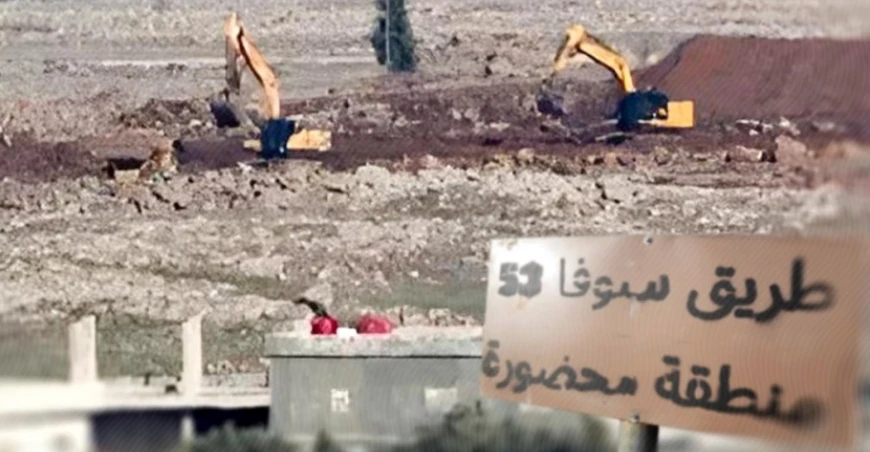
Israeli forces resumed excavation work west of the village of Asha in Quneitra countryside, Syria's Al-Ikhbariya television reported on Sunday, noting that the work is part of "Sufa 53," a project involving the construction of a road along the separation line in the border area.
The work comes amid wider Israeli military activity in southern Syria. Al-Ikhbariya has documented incursions into the countryside of Quneitra and Daraa in recent days, along with earthmoving, fortification work and the establishment of military positions.
Read more: Israeli incursions, shelling in Syria hit 2026 highs
Known also as the "Great Storm," Sufa 53 is an Israeli engineering and military project that began gradually in mid-2022 inside the buffer zone in Quneitra countryside. Although construction began before the fall of President Bashar al-Assad, the pace of the work increased in late 2024.
At the center of the project is an approximately 8-meter-wide military road, accompanied by earth berms reaching about 5 meters high, trenches and observation posts along a route bordering the Golan Heights inside the area of separation.
According to Syria's Sijil Center, which monitors Israeli operations, the project extends beyond a single site in Quneitra. It starts near the outskirts of Hader in the north, passes through Jabata al-Khashab and Hamidiya, then continues through Qahhtaniyah, Ruwayhina, Bir Ajam and Bariqa before reaching Asha and the border triangle in the south.
Sijil described the project as part of Israel's stated security arrangements along the border. Some observers cited by the Center, however, view the continuing engineering work as an effort to change conditions on the ground inside the buffer zone.
Read more: Israel's expansion in Syria: A looming threat to Iraq
In some areas, Israeli forces have advanced between about 300 and 1,000 meters into the buffer zone, according to reports. Local accounts have also described the appropriation of large areas of agricultural land for the project, including about 7,000 dunams in Jabata al-Khashab.
Israel did not comment on the Syrian allegation. However, it previously said its operations in southern Syria are based on "security considerations and the need to prevent potential threats along its border."
The current situation dates back to the disengagement agreement signed by Syria and Israel on May 31, 1974. The accord established separate military positions and a buffer zone between the two sides, with the United Nations Disengagement Observer Force (UNDOF) responsible for monitoring the area.
UNDOF monitors the ceasefire, oversees implementation of the disengagement agreement and maintains the buffer zone between Syrian and Israeli forces.
Read more: Syria's shifting stance: Is normalization with Israel on the horizon?