Iraqis among up to 8,000 migrants stranded in Spain’s Ceuta


Shafaq News- Madrid
Iraqis are among an estimated 5,000 to 8,000 migrants stranded in Spain's North African enclave of Ceuta, where thousands from the Middle East, North Africa, sub-Saharan Africa and South Asia remain caught in an unresolved asylum and reception crisis more than two weeks after a mass crossing from Morocco.
Ceuta and Melilla, Spain's two autonomous cities in North Africa, form the European Union's only land borders with Africa and have long been key migration routes through Morocco.
More than 72,000 people briefly entered Ceuta during the July 29-30 surge, most of whom later returned voluntarily, while at least 94 people died, according to Spanish and Moroccan figures. France24 reported on Sunday that those still in the enclave include Iraqis, Syrians, Yemenis, Palestinians, Egyptians, Algerians, Tunisians, Moroccans, Sudanese, Nigerians, Senegalese, Bangladeshis, Indians, and migrants from other African countries.
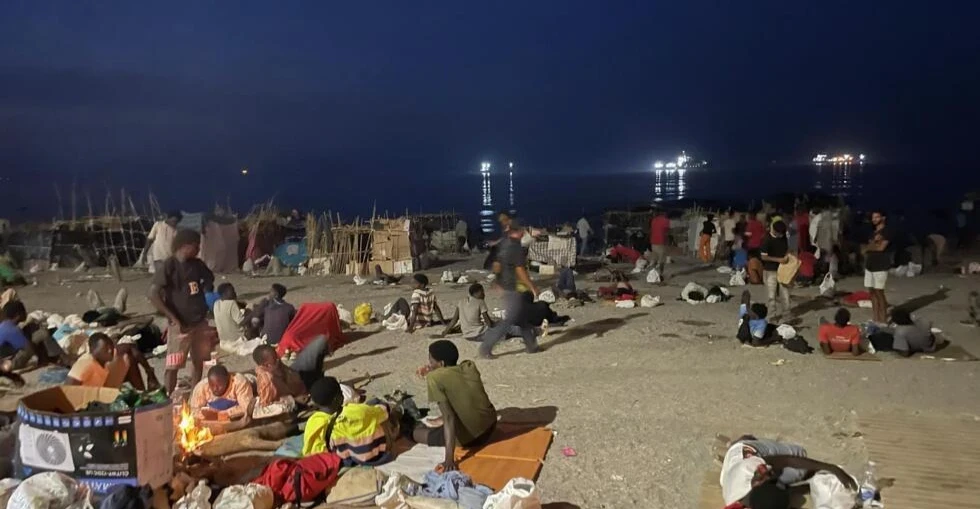
At El Trampolin beach, many have built makeshift shelters from reeds, cloth, and other available materials, forming loose groups by nationality. Migrants sleep on cardboard, wash clothes in the sea and share limited food and water while waiting for Spanish authorities to determine their legal status.
Among them is Abdulrahman, a young Iraqi from Mosul who had lived in Morocco for several years before reaching Ceuta. He told France24 that he hopes to regularize his status and travel to Sweden, where a relative lives.
Mohammed, a Syrian man in his 40s, travelled from Rabat toward the Moroccan border town of Fnideq with a Syrian family before entering Ceuta. Several Syrians were later returned to Morocco, he said, while he remained in the enclave. His child is still in Morocco, and his father travelled from Belgium but was unable to help him leave.
Abdulmajid, from Yemen, reached Ceuta a day before the main surge after swimming about eight kilometers. He has since been sleeping outdoors and hopes Spain will consider his asylum claim in light of the war in Yemen.
Two Egyptians, Tarek and Ramadan, described travelling through Libya, Tunisia, Algeria and Morocco, encountering violence and gunfire in Libya. Ramadan estimated that about 55 Egyptians had reached Ceuta.
Muzammil, a Sudanese man in his 30s, recalled spending his first three days in Ceuta without food or water after arriving by sea on July 30. Nigerian migrant Kamara, 35, said he now relies on food donations after years in Morocco, while Senegalese migrant Mamadou has applied for asylum and hopes eventually to join his brother in France.
The range of nationalities means there is no single legal outcome for those now stranded, as Spanish authorities assess international protection claims individually. Under Interior Ministry rules, once an asylum application is formally lodged, any return order is suspended until authorities decide whether the claim is admissible or rule on the case. Filing an application does not guarantee asylum.
Madrid-based migration lawyer Mohammed Sano told France24 that war or conflict in an applicant's country of origin may support a protection claim but does not automatically secure approval. Lawyer Bassem Salem similarly said nationality and individual circumstances would shape each case.
Processing the claims has added pressure to an already strained reception system. El Pais reported that migrants at El Trampolin have faced difficulties securing police appointments needed to formalize asylum requests.
Spanish Health Minister Monica Garcia said on Sunday that about 5,800 migrants had received medical care over the previous 15 days, while emergency activity rose by roughly 50% and 28 migrants remained hospitalized.
Hundreds of migrants also demonstrated in Ceuta on Sunday, demanding access to asylum procedures and opposing deportation to Morocco. Spain has deployed more than 500 additional officers to the enclave, bringing the security presence to more than 1,600, while Moroccan authorities have intensified efforts to prevent further large-scale crossings.