Munich 2026: Barzani’s constitutional bet on Syria and Iraq’s federal balance


Shafaq News
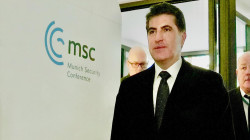
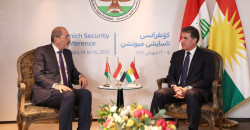
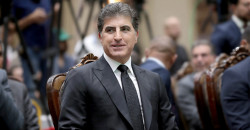
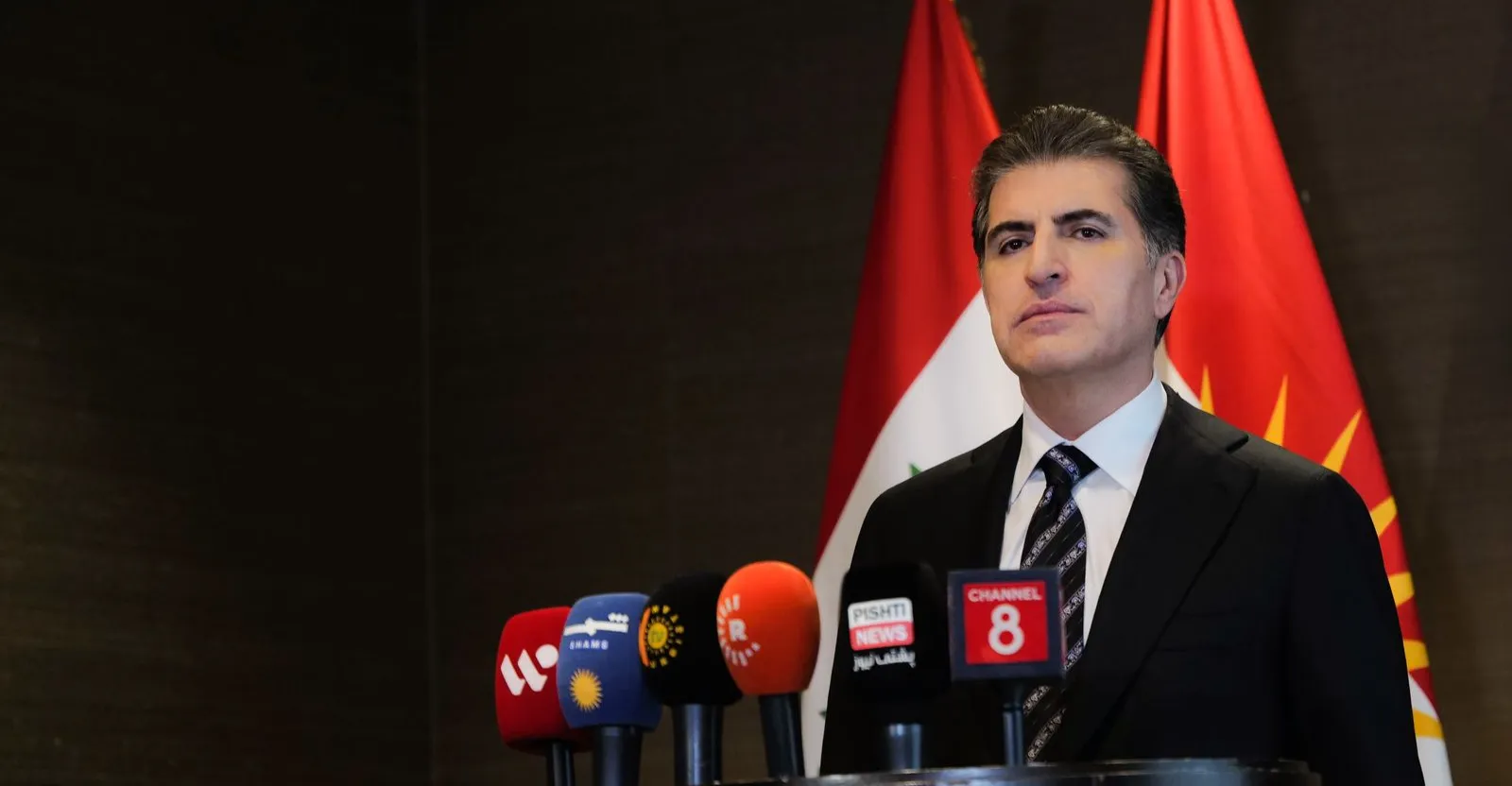
At the 2026 Munich Security Conference, Nechirvan Barzani did not unveil an initiative, nor did he seek dramatic headlines. Instead, the Kurdistan Region president used the gathering to advance a more calculated objective: shaping how the Kurdistan Region is positioned within Syria’s fragile transition, Iraq’s federal recalibration, and a regional order under strain.
Across his meetings, one formula consistently surfaced —unity paired with constitutional guarantees. It is a formulation that rejects fragmentation without endorsing unchecked centralization.
Syria: Unity As A Ceiling, Constitution As A Safeguard
Syria emerged as the most sensitive test of that formula.
In meetings with Syrian Transitional President Ahmad Al-Sharaa, Foreign Minister Asaad Al-Shibani, and Syrian Democratic Forces (SDF) Commander Mazloum Abdi, Barzani emphasized that any political settlement must secure Kurdish and minority rights within a unified Syrian state.
For Damascus, Barzani’s emphasis on “unity” defines the ceiling of negotiations and signals that decentralization, local governance, and security arrangements in the northeast cannot evolve into structural fragmentation.
His parallel message, however, was equally deliberate. Unity alone is insufficient if rights remain politically negotiable. He argued that protections must be embedded in Syria’s future constitution, the only durable guarantee in a country where previous settlements unraveled once military balances shifted.
On the sidelines of the conference, Barzani described the January 30 agreement between Damascus and the Kurdish-led SDF as a “positive step under current conditions,” while clarifying that the Kurdistan Region’s support for northeast Syria is political rather than military. He also cautioned against replicating the Iraqi Kurdistan model in Syria, noting that political and geographic conditions differ fundamentally.
The approach reflects a calibrated middle ground: neither separation nor absorption, but codified inclusion.
Washington: Stability Through Partnership
Barzani’s discussions in Munich also reaffirmed Erbil’s strategic alignment with Washington.
In talks with US Secretary of State Marco Rubio, discussions covered the implementation of the Damascus–SDF understandings and broader regional security dynamics. Official readouts described the Kurdistan Region as a partner in counterterrorism coordination.
His meeting with US Under Secretary of State for Political Affairs Allison Hooker, alongside Senator Lindsey Graham and a congressional delegation, focused on safeguarding Iraq’s sovereignty, maintaining cooperation against ISIS, and preserving the Kurdistan Region’s constitutional status within federal Iraq.
The significance lies less in protocol and more in positioning. As Syria’s transition unfolds and Iraq navigates its own political recalibration, Erbil continues to function as a stabilizing channel in files that intersect security, federalism, and regional diplomacy.
Europe: Security Linked To Development
European meetings expanded the scope beyond counterterrorism.
German Defense Minister Boris Pistorius confirmed the extension of Germany’s military mission in Iraq, maintaining training support for Peshmerga forces. Talks with French President Emmanuel Macron, European Commission President Ursula von der Leyen, and senior German economic officials addressed Syria’s transition, minority protections, and economic cooperation.
According to UN estimates, the Kurdistan Region hosts around 102,000 displaced persons across 20 camps —a humanitarian burden that intersects with Europe’s migration anxieties and long-term stability calculations.
In this framing, Barzani stressed that security must be accompanied by development and political stability.
Domestic Timing: Federal Balance Under Negotiation
Munich unfolded against an unsettled domestic backdrop.
Iraq is preparing to select a new president, a position traditionally held by a Kurdish figure under the post-2003 political system. The November 2025 parliamentary elections strengthened the Kurdistan Democratic Party (KDP), which secured 32 of the 46 seats allocated to Kurdish representatives in the federal parliament, including minority quotas. Within the Kurdistan Region’s own parliament, the KDP holds 39 of 100 seats.
Yet the Region remains without a new government more than a year after regional elections, with negotiations between major Kurdish parties still ongoing.
Shortly before departing for Munich, a second meeting took place between KDP leader Masoud Barzani and Patriotic Union of Kurdistan (PUK) leader Bafel Talabani. Nechirvan Barzani said discussions were moving “in a direction that serves the interests of both the Kurdistan Region and Iraq,” though no final agreement has been reached.
Beyond Munich: A test outside conference halls
The 2026 conference did not produce binding agreements or public breakthroughs. Its significance lies in framing.
On Syria, Barzani advanced a doctrine that pairs territorial unity with constitutional entrenchment of rights. On Iraq, he reaffirmed federalism as a stabilizing principle rather than a temporary arrangement. Internationally, he presented the Kurdistan Region as a security partner, diplomatic intermediary, and humanitarian buffer.
The next test will unfold beyond Munich’s meeting rooms —in Damascus’ constitutional process, Baghdad’s negotiations over federal authority and resources, and the trajectory of Kurdish intra-party talks.
If stability in the region depends not only on battlefield outcomes but on political frameworks that survive power shifts, then the debate Barzani advanced in Munich centers on one question: whether unity can endure without written guarantees.
Written and edited by Shafaq News staff.