Jurf Al-Sakhar: A decade on, Iraq's displaced still barred from return


Shafaq News
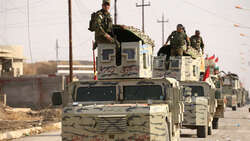
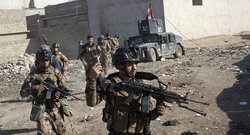
More than a decade after Iraqi forces recaptured Jurf Al-Nasr (formerly Jurf Al-Sakhar), north of Babil province, from ISIS in October 2014, the return of its displaced residents remains stalled due to security complications, political disagreements, and the entrenched influence of armed forces, making it one of Iraq’s most enduring displacement cases since 2003.
Political and parliamentary estimates put the number of displaced from the district and nearby communities at more than 120,000, predominantly from the Sunni Al-Janabi tribe, most of whom have been away from their homes since the 2014 offensive. According to Ali Abbas Jahakir, spokesperson for the Ministry of Migration and Displaced Persons, around 6,000 displaced families from Jurf Al-Sakhar still reside in Al-Musayyib, Ameriya Al-Fallujah, and Al-Sulaymaniyah in the Kurdistan Region, with no clear pathway to return yet established.
The area holds significant strategic importance due to its location between Baghdad and Iraq’s southern provinces —Basra, Al-Muthanna, Maysan, and Dhi Qar— as well as the continued presence of Popular Mobilization Forces (PMF) formations.
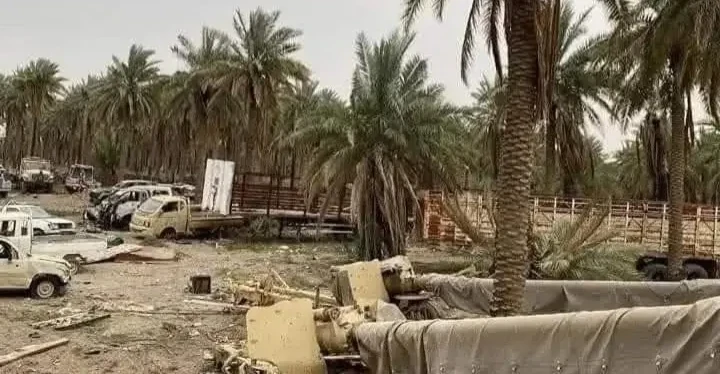
Jurf Al-Nasr returned to the security spotlight in 2026 after a series of airstrikes targeted locations inside the district. The strikes, attributed to US drones, hit PMF sites and storage facilities linked to Iran-aligned armed factions. The incidents killed at least two and injured dozens, underscoring the area's continuing role as a sensitive security and military zone within broader regional tensions involving the United States, Iran, and Tehran-backed armed factions in Iraq.
The political dimension surfaced sharply in June 2026, when Babil Governor Ali Turki Al-Jamali ruled out the displaced residents' return in a public message, arguing that the land they left was held under expired state agricultural leases rather than private title.
The statement drew swift condemnation. The Head of Al-Siyada Party, Khamis Al-Khanjar, one of the most influential Sunni political figures in Iraq, described the governor's remarks as “an open declaration of a sectarian demographic-change project in the province.”
Tribal sheikhs from Al-Anbar convened a gathering to demand that Jurf Al-Sakhar's residents be allowed to return, attributing the unresolved issue to "political reasons." Sheikh Abdul Rahim Muhammad Ajaj Al-Asafi told Shafaq News that the displaced hold the same right of return as any other Iraqis, and rejected any attempt to bend their cause to a sectarian narrative or to exploit the displacement file for political ends.
Muhammad Al-Asafi, a notable from Ramadi, told Shafaq News that displaced families from Jurf Al-Sakhar, among them the elderly, the sick, women, and children, endure harsh conditions, calling on the federal government to shoulder their responsibility toward the file, and tribal sheikhs “to resist any rhetoric that threatens civil peace,” warning that the moment demands a unified stance rather than division.
Read more: Iraq to place armed factions' weapons under state control
The debate surrounding the district also extends to its name. Iraqi authorities renamed Jurf Al-Sakhar to Jurf Al-Nasr after recapturing the area from ISIS in late 2014. However, the new designation remains contested, and many Iraqis and media outlets continue to use the historical name, Jurf Al-Sakhar.
Following large-scale military operations that concluded in 2014, Iraqi authorities announced the recapture of Jurf Al-Nasr, opening a new phase of debate over control of the area.
The district gradually became a closed military zone, with conflicting accounts regarding access and civilian return. In 2017, Babil’s Provincial Council sparked controversy after approving a decision, endorsed by the State of Law Coalition (SLC), the Shia bloc led by former Prime Minister Nouri Al-Maliki, to pursue legal action against any party calling for the return of displaced residents. Sunni political groups at the time viewed the move as evidence of the issue's growing complexity, while the United Nations criticized it as a restriction on the discussion of displaced persons' rights. “The ability to return to one’s own home is a fundamental right that must be respected,” said the Deputy Special Representative of the United Nations Secretary-General for Iraq, Gyorgy Busztin, at that time.
Since 2019, the district has increasingly been viewed as a closed military enclave with strategic significance.
Researcher and academic Ziad Al-Arrar divided the reasons behind the continued displacement into three main factors: security procedures on the ground, opposition from Iran-aligned armed factions to residents’ return, and plans to relocate some displaced people to other areas.
Speaking to Shafaq News, Al-Arrar accused some Sunni political forces of “remaining largely silent” on the issue, saying only a limited number continue to advocate for residents’ return.
He noted that the process depends on a political decision and high-level agreements among Iraq’s leadership, arguing that the continued deadlock is linked to political disputes and the presence of armed actors that oppose the return of residents.
“The current government may have an opportunity to reopen the file and address the suffering of more than 120,000 displaced people, although there are no decisive indications of progress so far.”
Read more: Iraq stands to gain most from US-Iran deal
Kamel Nawaf Al-Ghariri, secretary-general of the Iraq Is Our Identity Party (Iraq Hawiyyatuna) and a former member of parliament, said successive Iraqi governments had engaged with political forces on the issue but failed to achieve the return of displaced residents.
In an interview with Shafaq News, Al-Ghariri noted that the reasons behind the continued displacement “remain unclear,” and called on the government to provide greater transparency. He expressed hope that authorities would facilitate the return of residents under the supervision of Iraq’s army and police forces.
Al-Ghariri also held previous governments responsible for the prolonged displacement, arguing that the defeat of ISIS in Iraq “removes any justification for keeping the file unresolved.”
Former Babil lawmaker Hassan Fadham described the Jurf Al-Nasr issue as complex and difficult, citing the absence of political consensus and the lack of a clear security arrangement for managing the area after residents return.
Fadham indicated that tens of thousands of landmines and improvised explosive devices remain uncleared, posing risks to civilians and security forces alike. “The district’s infrastructure has been destroyed and requires extensive reconstruction efforts before large-scale returns can take place.”
According to Fadham, the area's sensitive location near Baghdad, Karbala, and Babil means that “any return process must be tied to a comprehensive security and reconstruction plan.”
Political researcher Mujasha Al-Tamimi stressed that the issue has evolved beyond its immediate humanitarian dimension and is now “tied to broader security and political arrangements established after 2014.”
Al-Tamimi told Shafaq News that the main obstacles include persistent security concerns, the absence of full political consensus, the involvement of multiple influential actors, and the need for extensive security and administrative vetting.
He also proposed the formation of a joint high-level committee comprising government officials, security agencies, and representatives of displaced residents “to develop a publicly announced roadmap for return, reconstruction, and security guarantees.”
Read more: Jurf Al-Sakhr displacement saga: political struggles and security concerns
Written and edited by Shafaq News Agency staff.