Iraq’s government under fire: Lawmakers decry 'clear neglect' on water crisis


Shafaq News
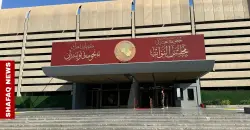
Iraq’s parliamentary Committee on Agriculture, Marshes, and Water has accused Prime Minister Mohammed Shia al-Sudani of neglecting the country’s worsening water crisis, urging him to address it with the same urgency as the upcoming elections.
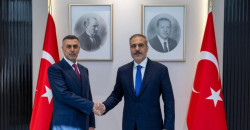
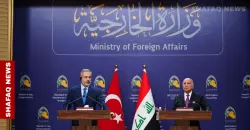
Committee member and State of Law Coalition MP Thair Mukhif highlighted to Shafaq News that the government has displayed “clear negligence” despite Iraq fulfilling its commitments to Turkiye — including reopening the Ceyhan oil pipeline, expanding trade, and granting Turkish companies major investment projects.
“The water releases remain extremely limited,” he warned, emphasizing that the shortage is taking a heavy toll on both the environment and agriculture.
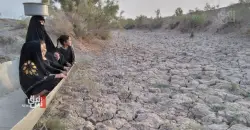
In Maysan, Agriculture Director Majid al-Saedi reported that farming has nearly stopped amid widespread drought. More than 60% of the province’s population relies on agriculture, he noted, but the summer planting season was fully suspended, and the winter plan remains pending.
Noting that many marshland residents have been forced to leave their homes and sell their buffalo at low prices as the animals cannot survive without water, Al-Saedi cautioned that ongoing drought could push thousands of families toward economic collapse.
“Over 90% of Maysan’s marshes have dried up,” he added.
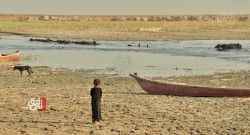
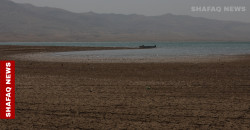
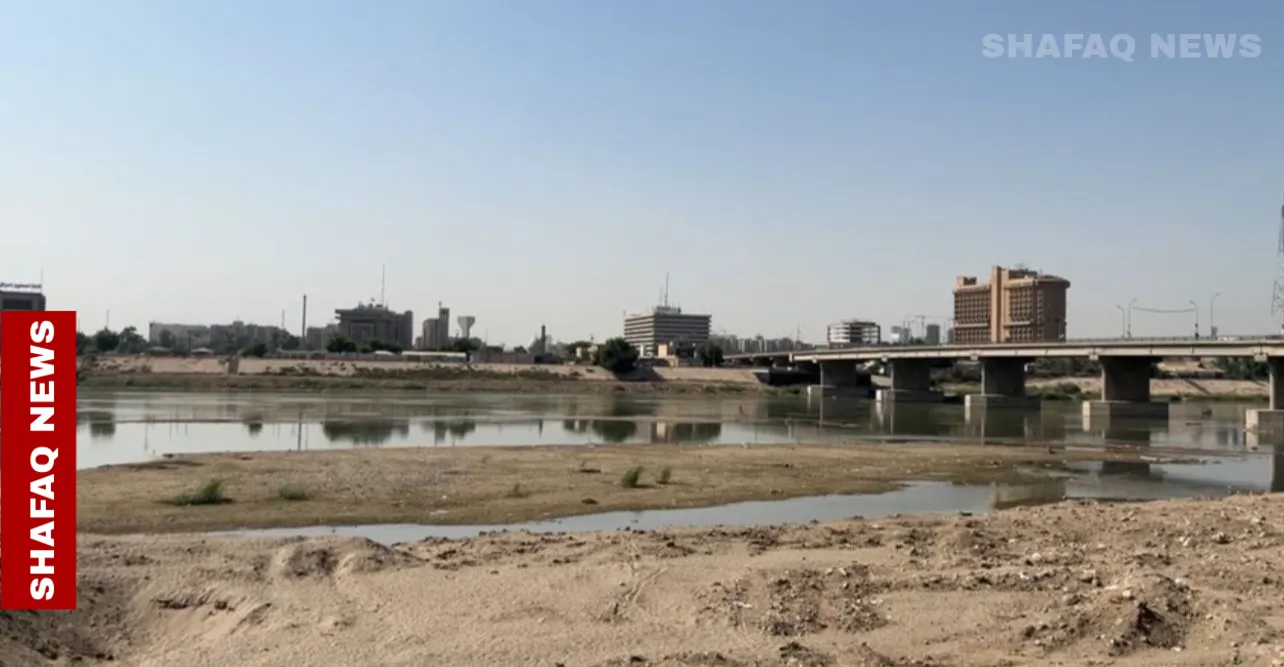
Images and footage obtained by Shafaq News illustrate the scale of the crisis. Along parts of the Tigris and Euphrates, particularly near the Anah Water Project in western Iraq, riverbeds have emerged, mud islands have formed, and some sections have become shallow enough to cross on foot.
Read more: A century of promises: Iraq’s water diplomacy with Turkiye and Iran
Ali Jassim al-Masafari, head of the Gilgamesh Foundation for Antiquities and Marshes, highlighted to Shafaq News that water levels in Baghdad have declined sharply as releases from the Mosul Dam decrease.
The normal outflow from the dam should be at least 350 cubic meters per second, he explained, while current levels are around 210, with Turkiye’s share down to roughly 130 cubic meters per second.
Warning that continued shortages could deplete Iraq’s reserves and risk drying up the Mosul Dam by the end of November, he pointed out that rainfall is now the only hope for recovery.
Moreover, former lawmaker Jamal al-Bateekh urged stronger diplomatic action, framing the water crisis as “a political issue that touches every citizen,” and emphasized that Baghdad should leverage trade pressure or submit international complaints to the UN Security Council or the European Union to secure its fair share of water.
The United Nations ranks Iraq among the world’s five countries most vulnerable to climate change. In 2022, the World Bank warned that Iraq faces an “urgent climate challenge” and requires greener, low-carbon development.
Earlier this year, the Strategic Center for Human Rights also documented that Iraq has lost approximately 30% of its arable land over the past three decades, threatening food security and long-term stability.
Iraq has endured four major droughts — in 2017, 2021, 2023, and 2025 — with environmental expert Ahmed Saleh describing the most recent as “the harshest in nearly 80 years.”
Written and edited by Shafaq News staff.