Iraq’s factories await revival after years of decay


Shafaq News
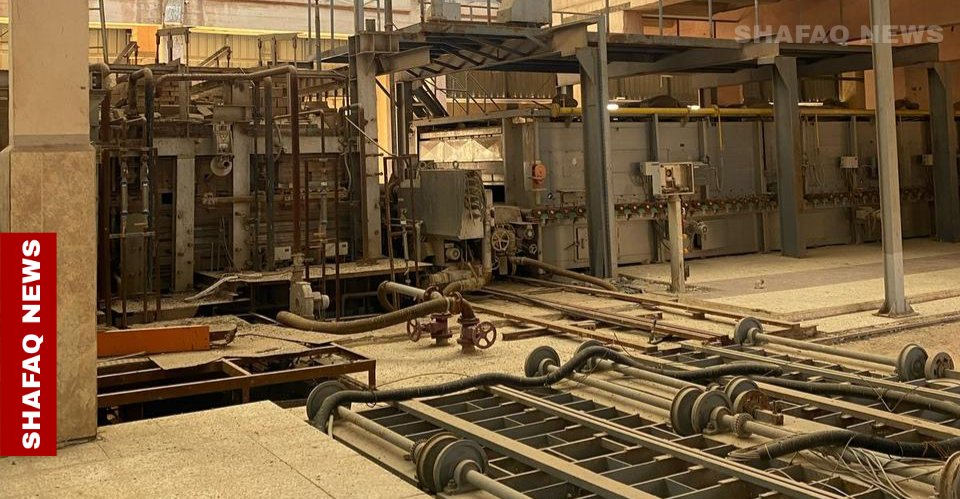
Thousands of factories across Iraq remain idle more than two decades after shutting down, leaving machines rusting in silence and a once-vital sector struggling to restart production.
State Factories Struggle
Only 15 to 20 state-owned factories remain in operation, mostly in military production such as ammunition and materials for the army and police, as well as iron and cement. Four textile plants in Baghdad, Najaf, Al-Anbar, and Babil produce between 28,000 and 33,000 square meters, though operations often stop and resume depending on government allocations of 3 to 5 billion dinars ($2.1–$3.5 million) per round.
In Babil, a government complex includes five smaller units producing plastic bags, medical supplies, fabrics, and synthetic fibers. Chronic underfunding has left these plants functioning intermittently.
A shortage of skilled labor further compounds the problem. Thousands of engineers and workers have been idle for more than 20 years, leaving them outside the technological developments shaping modern industry. Officials admit Iraq now needs specialized expertise to revive its public factories.
Private Sector Burden
The private sector has faced a different reality. Around 50,000 plants have been inactive since the Iran–Iraq war and subsequent events after 2003, with no state rehabilitation programs.
Roughly 30,000 private factories are currently operating, but rely entirely on their own resources without government support despite repeated cabinet pledges. Abdul-Hassan al-Ziyadi, a member of the Iraqi Industries Union, told Shafaq News that the sector continues to face serious obstacles, chiefly the absence of real government support and facilities despite numerous cabinet resolutions.
Read more: Can "Made in Iraq" rise again?Challenges and hopes for local manufacturing
A senior Industry Ministry source told Shafaq News that cabinet decisions under Prime Minister Mohammed Shia al-Sudani — including loans and measures to supply gas and electricity — have largely remained on paper. Some were partially implemented, while others served only as public announcements.
In April 2025, the government reviewed support options, discussing loans, property transfers, industrial cities, and export mechanisms. The meeting also addressed fees, rents, and accounting oversight. Al-Sudani pledged at the time to launch a second package of measures to bolster industry, diversify income, and create jobs.
Written and edited by Shafaq News staff.