Iraq’s death sentence for Syrian man tests fragile refugee–host ties


Shafaq News – Baghdad
A death sentence handed down by an Iraqi court against a Syrian national convicted of terrorism has unsettled the country’s large Syrian refugee community and reignited debate over how Iraq balances justice, security, and social cohesion in the post-ISIS era.
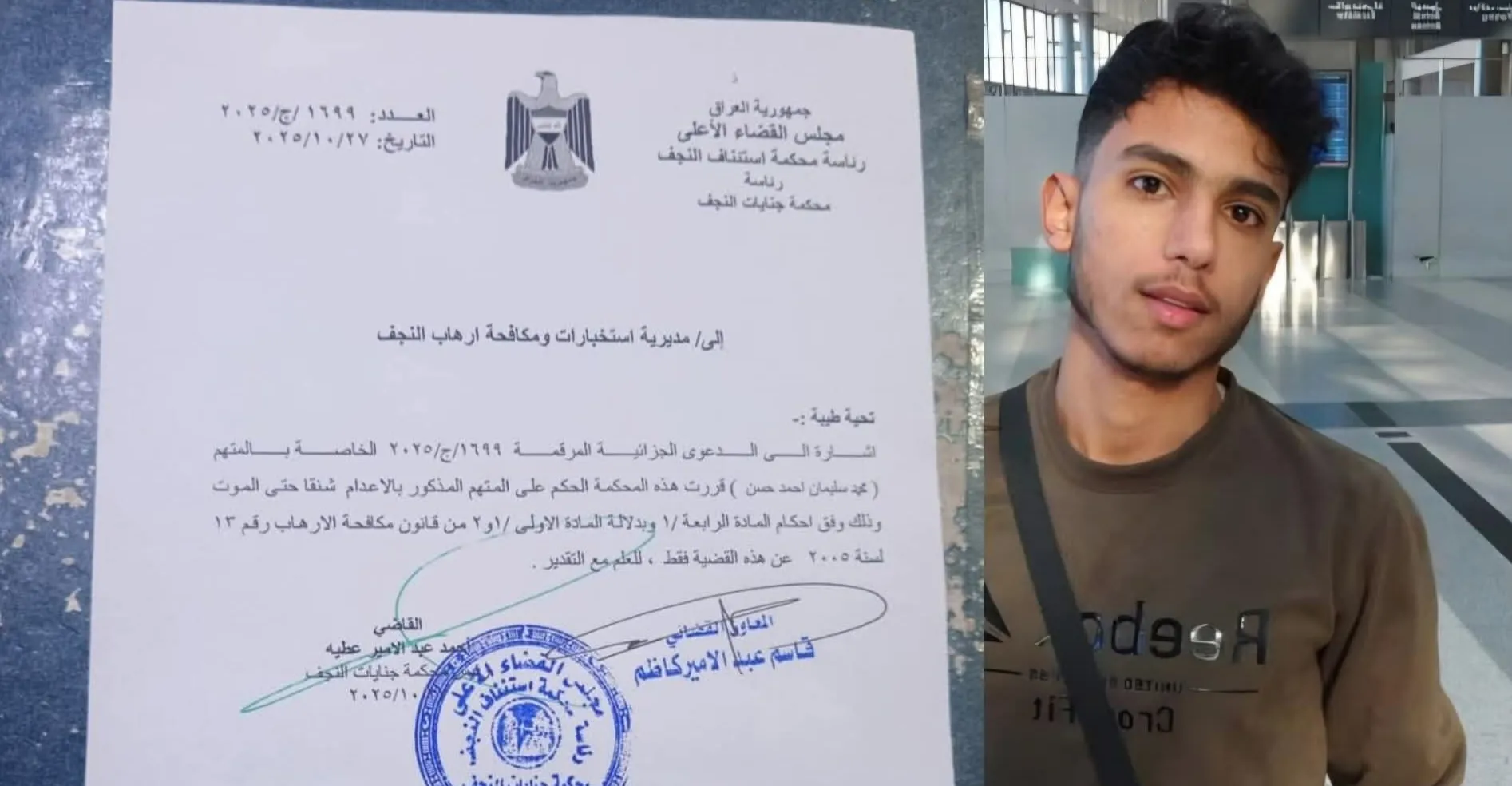
The Najaf Criminal Court sentenced Mohammed Suleiman Ahmed, a Syrian citizen, to death under Article 4 of Iraq’s Anti-Terrorism Law, which prescribes capital punishment for those found guilty of committing, assisting, or financing terrorist acts. The court said the ruling followed full legal procedures and a confession from the defendant.
While the judiciary defended the verdict as due process, its impact has reverberated far beyond Najaf, stirring fear among Iraq’s roughly 250,000 Syrian residents, many of whom worry that one man’s crime could taint an entire community.
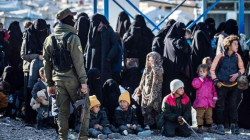
Refugees Fear Backlash
In Baghdad, where tens of thousands of Syrians work in trade, construction, and small industries, the case has sparked anxiety about collective blame.
“We respect Iraq’s courts and trust their fairness,” said Mohammed al-Halabi, a Syrian merchant who has lived in the capital since 2015. “But we fear that online campaigns could stigmatize Syrians because of one man’s actions. Most of us live and work here with dignity.”
Similar concerns emerged in Kirkuk, a city already marked by political and ethnic strain. “We live among Iraqis as brothers,” said Omar Abdullah, a Syrian clothing trader. “But this verdict created unease. We fear hostility or misunderstanding, especially in areas already on edge.”
Even in the Kurdistan Region, where Syrian refugees generally enjoy greater legal and economic stability, apprehension grew. “Relations between Syrian and Iraqi Kurds are strong,” said Samir al-Qamishli, a resident of Erbil. “But the news reminded people how vulnerable refugees remain to political shocks.”
Between Law and Public Perception
Legal experts view the Najaf ruling as consistent with Iraq’s counterterrorism framework, but acknowledge its political and social sensitivities.
According to Iraqi officials, who spoke to Shafaq News, the challenge is maintaining trust between communities, pointing out that the Syrian population here is diverse—workers, traders, families—and “none should be judged through the lens of one case.”
Under Article 4, enacted in 2005, thousands of defendants have faced the death penalty for terrorism-related crimes. Iraqi officials argue the law remains essential for deterrence, while rights groups say it relies too heavily on confessions and lacks sufficient judicial oversight.
The verdict’s timing and visibility have amplified its sensitivity. Many Syrians in Iraq have spent over a decade rebuilding their lives after fleeing war and economic collapse at home. According to the Interior Ministry, about 180,000 Syrians hold valid residency permits, while humanitarian organizations estimate that tens of thousands more remain undocumented because of legal and financial obstacles.
Tensions Spill Toward the Border
The ruling coincided with a separate incident near the al-Bukamal border crossing, where four Iraqis returning from Syria were reportedly robbed and assaulted by armed men “believed to be Syrians,” local sources told Shafaq News. The attack raised fears of reprisals or resentment linked to the Najaf verdict.
A security official in al-Anbar Province urged calm, saying to Shafaq News that the assault appeared “criminal rather than retaliatory.” He added that Iraqi forces had tightened security along the frontier to prevent escalation. “The al-Bukamal attack does not represent Syrians as a whole,” the official said.
The Iraqi–Syrian border—stretching more than 600 kilometers from Sinjar in Nineveh Province to al-Qaim in al-Anbar—remains one of the region’s most volatile frontiers, patrolled by Iraqi border guards and Popular Mobilization Forces (PMF) amid ongoing concerns about smuggling and residual ISIS activity in the desert belt between the two countries.
Fragile Coexistence
Most Syrians in Iraq have become integral to the urban workforce yet continue to face bureaucratic hurdles, social prejudice, and economic vulnerability. Many now fear the Najaf ruling could harden public attitudes or embolden discriminatory rhetoric online.
“The court’s decision shouldn’t reflect on thousands of Syrians living legally in Iraq,” said Ahmed Abd al-Rahman al-Dimashqi, a food trader in Baghdad. “We are guests who respect the law and contribute to this country’s economy. One person’s crime shouldn’t define an entire community.”
Though limited to a single case, the Najaf sentence has become a prism through which Iraq’s broader post-war dilemmas are refracted: how to enforce justice without deepening divides, secure borders without inflaming prejudice, and uphold the rule of law while safeguarding fragile coexistence.
Written and edited by Shafaq News staff.