Iraq detains top officials in anti-corruption sweep: What we know so far


Shafaq News (Updated on June 30, at 9:17)
Iraqi security forces detained 67 officials, lawmakers, and businessmen across Baghdad and several provinces on Sunday in the Dawn Crackdown, one of the country's largest anti-corruption operations in years, according to security and judicial sources. The arrests, which began before dawn on June 28 and were carried out under the direct supervision of Prime Minister Ali al-Zaidi, form the first phase of a wider campaign that officials say could reach more than 200 senior figures in the state within 72 hours.
Who Was Detained, Who Is Next?
The official state news agency (INA) named those held, led by Muthanna al-Samarrai, head of the al-Azm Alliance and a member of parliament. The list also included sitting lawmakers Ziyad al-Janabi, Bahaa al-Nouri, Mohammed al-Karbouli, Aliya Nasif, Mohammed Jamil al-Mayahi, Hassan al-Khafaji, Abdul Rahman al-Luwaizi, Mudhar al-Karaawi, Hind al-Abbasi, Mohammed Furman al-Jubouri, and Bushra al-Qaisi.
Also named were former lawmaker Mohammed al-Sayhoud, Oil Ministry Undersecretary for Distribution Affairs Ali Maarij, and former government adviser Ibrahim al-Sumaidaie.
The detainees also included civil servants, directors general, politicians, and businessmen. According to Shafaq News sources, a second planned phase would reach political bodies, lawmakers, directors general, and businessmen described as "first-degree" figures.
On Monday, Government Spokesman Haider al-Aboudi stated that 21 individuals have been arrested in connection with the Dawn Crackdown, without providing the names of those arrested or specifying charges.
How the Operation Unfolded
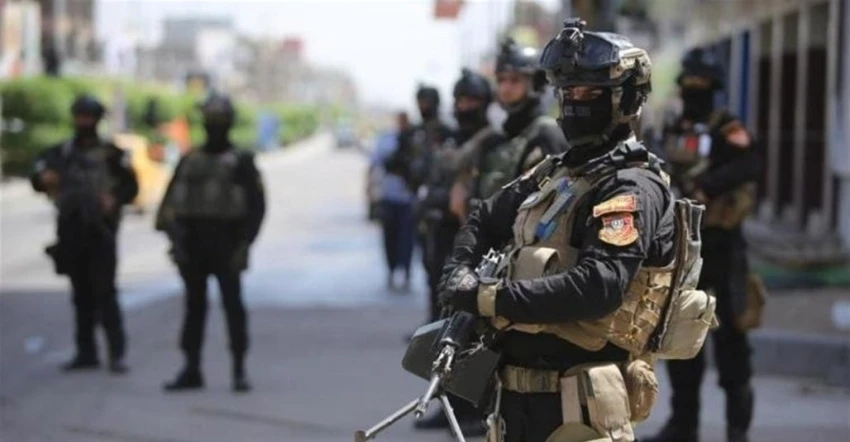
A security source told Shafaq News that the security forces sealed off the entrances to the Green Zone, Baghdad's fortified government district, at dawn on Sunday. Counter-Terrorism Service (CTS) units set up dense checkpoints and screened anyone leaving, with the only exemption granted to students carrying examination cards.
The Special Division detained more than eight people at dawn, among them members of parliament, on judicial warrants tied to financial and administrative corruption, the same source said, adding that a CTS unit pushed into the al-Shaab district north of the capital to carry out similar warrants.
The raids extended beyond the Green Zone and al-Shaab to several Baghdad districts, including Sadr City, Zayouna, al-Yarmouk, al-Mansour, and the al-Qadisiyah residential complex, as well as several provinces, including Babil, Maysan, al-Anbar, and Erbil. A second security source said the operation also reached the Midland Oil Company over allegations that staff were involved in financial corruption, while travel bans were imposed on several politicians and businessmen until the investigations are completed.
The operation passed without any security breaches, friction, resistance, or exchange of gunfire, another informed source told Shafaq News, adding that armored vehicles were moved only to close the entrances to the Green Zone as a precaution.
“Several wanted individuals have either fled or gone into hiding inside Iraq, but tightened border and internal security measures have prevented any confirmed exits from the country,” the source added, noting that the number of arrests will “definitely increase.”
All detainees were handed to the Integrity Commission, and large sums of cash were seized at the homes and offices of those held, to be announced once final accounting is complete, the same source said.
The inquiry drew in part on the testimony of detained officials, including former Oil Ministry Undersecretary for Refining Affairs Adnan al-Jumaili, whose confessions are believed to have opened new files and led to arrest warrants against others linked to government contracts and deals, according to security and judicial sources. Some of those sought managed to leave their offices before the raids, prompting forces to tighten measures, the sources said, with officials remaining silent on the final number of detainees and the nature of the files.
Reactions And Support
Anti-corruption sits at the top of the agenda for the new government of Prime Minister Ali al-Zaidi, whose program commits to institutional reform across ministries, digital transformation to cut bureaucracy, financial investigation mechanisms running alongside legal proceedings, decentralization of authority to the provinces, and a national anti-corruption framework.
During a cabinet session today, al-Zadi framed the ongoing campaign as the initial phase of wider efforts to recover public funds and strengthen oversight across state bodies.
“The situation surrounding corruption and financial mismanagement can no longer be tolerated and ignored,” he added, citing the need for stronger monitoring tools and closer scrutiny of performance across ministries and public agencies.
The arrests are continuing as part of that plan, and the approach will persist as a pillar of state sovereignty, government spokesman al-Aboudi told media outlets, adding that the campaign had drawn praise for being conducted transparently to protect public funds.
The Federal Integrity Commission, Iraq's main anti-corruption body, described the operation as the fruit of joint and complementary efforts among the judicial, executive, and legislative authorities alongside its own work.
Support came from many political parties and figures, including the head of the State of Law coalition. The Shiite Coordination Framework (CF) expressed support for the government's and judiciary's efforts to restore confidence in the political process, stressing the need to sustain anti-corruption measures, remove corrupt and negligent officials from state institutions, and prevent the waste of public funds.
Former PM Nouri al-Maliki congratulated al-Zaidi on the pursuit of those accused of corruption and affirmed his backing for the effort. Muqtada al-Sadr, head of the Patriotic Shiite Movement, also voiced support, urging al-Zaidi to press ahead with corruption cases regardless of the suspects' political affiliation.
The Reconstruction and Development Coalition, led by former Prime Minister Mohammed Shia al-Sudani, voiced support for the government's campaign, warning against “misinformation” spread by those implicated in corruption cases. The Kurdistan Democratic Party (KDP) parliamentary bloc called for the government’s drive to be sustained, with investigations and enforcement expanded beyond Baghdad to all Iraqi provinces.
The Kurdistan Islamic Union (KIU) praised the drive as a historic turning point and a key step toward strengthening state institutions.
The head of the Al-Hikma Movement, Ammar al-Hakim, welcomed the recent measures as "an important move toward consolidating the rule of law, protecting public funds, and strengthening citizens' confidence in state institutions."
The National Political Council (NPC), a Sunni umbrella bloc formed after the 2025 parliamentary elections with about 77 seats, endorsed the recent wave of anti-corruption arrests, hailing the coordinated action among Iraq’s executive, legislative, and judicial institutions to recover public funds and strengthen oversight across state bodies.
Mukhtar al-Moussawi, a deputy representing the Badr bloc led by Hadi al-Ameri, told Shafaq News that the Iraqi government's anti-corruption campaign will encompass all levels of government, pledging parliamentary support for Prime Minister Ali al-Zaydi's enforcement operations. He also framed US support as a critical factor enabling the identification and arrest of corrupt officials.
In parliament, Hamed al-Fatlawi, a member of the Integrity Committee, told Shafaq News that the drive marked a fundamental shift because it was the first to reach high-ranking political figures, adding that the inquiry remained confidential and that further suspects had yet to be named. He urged that the campaign be expanded nationwide to prosecute any governor, director general, or official found guilty, regardless of political affiliation.
Iraq's Bar Association declined to provide legal defense for those detained in the campaign. In a statement, it welcomed “the serious and practical steps to confront corruption.” The association described the campaign as a potential turning point that could open a new window for Iraqis, provided it was matched by sustained political will to recover state assets, enforce accountability, and strengthen institutions.
The Leading Tribal Councils in Al-Diwaniyah, Karbala, Babil and Dhi Qar, the most influential tribal bodies in the provinces, declared their support for al-Zaidi and pressed for a tougher line against corruption across state institutions.
The head of the Integrity Committee in the Dhi Qar Provincial Council, Abdul-Baqi Al-Omari, called for stricter anti-corruption measures and a "night of anger" similar to the campaign underway in Baghdad.
Al-Azm Alliance defended its leader, Al-Samarrai, and several alliance lawmakers facing corruption-related charges, urging political actors and media outlets not to prejudge the case while expressing confidence in the country's judiciary. The Alliance called for the proceedings to be handled in accordance with constitutional and legal guarantees, maintaining that due process and fair trial protections should be respected throughout the investigation.
Omar al-Karawi, head of Diyala Provincial Council, said Monday that the arrest of his brother, Deputy Mudhar al-Karawi, cannot be separated from his political stances, expressing confidence in Iraqi judicial processes to clarify the circumstances of the arrest. “Mudhar al-Karawi maintained clear and consistent positions defending the people of Diyala, particularly in the Hamrin Basin, and rejected attempts at marginalization and demographic change; his arrest is inseparable from this political track record.”
Omar al-Karawi alleged that his brother received a warning call from a political figure hours before security forces raided his residence, but refused to leave the country and expressed willingness to appear before any investigative committee. He said no money or incriminating documents were found during the operation.
The Wider Context
Iraq still ranks low on international transparency measures, placing 136th out of 182 countries in the 2025 Corruption Perceptions Index. Various estimates indicate the country lost hundreds of billions of dollars over the past two decades to corruption and mismanagement, with some official sources putting the wasted sums at between 150 and 300 billion dollars. The arrests also follow a broader campaign in recent weeks that led to the dismissal of a number of officials over corruption, negligence, and the waste of public funds, including at the Ministry of Electricity.
The campaign also revives Iraq's long-stalled "Where Did You Get This?" initiative, a national anti-corruption effort first launched in 2023 by the Federal Commission of Integrity in cooperation with state oversight bodies that scrutinize whether officials' wealth matches their declared income. According to judiciary source, the file had been shelved under political pressure but was reopened with judicial backing as Iraq's financial position worsened.
It unfolds after Iraq's most notorious graft case, known as the Theft Of The Century, the embezzlement of roughly 2.5–3.7 trillion dinars ($1.9–$2.8B), from the General Commission of Taxes through hundreds of forged checks cashed between 2021 and 2022. Thirteen people were convicted over that theft in 2024, and the case resurfaced in May 2026, days after parliament approved al-Zaidi's government, with a recovery committee citing a far higher estimated value of about 5 billion dollars.
What Experts Say
The campaign marks an important beginning, according to Mohammed al-Rubaie, head of the Al-Nahrain Foundation for Supporting Transparency and Integrity (NFTI), who told Shafaq News that holding suspects accountable could recover large sums, ease financial pressure on the state, and restore public confidence in reopening files frozen for years.
Iraq's judicial cooperation agreements with several countries, he added, could open the way to pursuing suspects abroad and recovering smuggled funds, particularly if those funds were tied to cross-border activity.
Academic and political researcher Khaled al-Ardawi said corruption had become a leading factor weakening state institutions since 2003 and had grown into an interlinked network spanning sectors, describing the investigations as “a snowball in which confessions lead to new files and widen the circle of suspects.” Success, he said, would depend on judicial independence and the resolve of law enforcement to reach everyone involved, current and former officials alike.
Files of this scale could not have been opened without clear resolve from the judiciary and the Federal Integrity Commission, said Issam al-Faili, a political science professor at Mustansiriyah University. “Corruption had embedded itself in state institutions under political and administrative cover, and reviewing high-value government contracts could expose more complex cases.”
He warned that entrenched corruption threatened the stability of the state much as unregulated weapons threatened its security, noting that some networks cut across political and sectarian lines and rested on shared financial interests.
What is Next
Iraq's anti-corruption campaign will target more than 200 officials, politicians, former and current deputy ministers, and business owners during its initial 72-hour phase as part of a six-month operation, two of the sources confirmed, and would extend beyond Iraq's borders, with authorities preparing arrest warrants and coordinating with Interpol to pursue suspects abroad and recover assets acquired through the misuse of public funds and state institutions for personal gain.
Authorities are also working to lift parliamentary immunity for suspects named in legal case files to enable judicial proceedings, a step one source said could help recover millions of dollars during the campaign's first phase.
Al-Aboudi added that PM al-Zaidi has instructed the Ministry of Finance to establish a dedicated account to deposit funds recovered from those convicted in embezzlement cases and that anti-corruption enforcement under the current government “differs substantially from previous administrations.”