Iraq caught between US-Iran war and September 30 deadline


Shafaq News- Baghdad
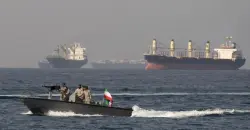
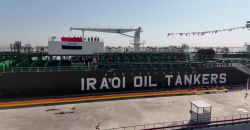
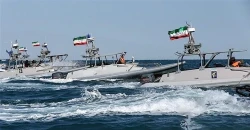
The maritime war between the United States and Iran flared back into open fire this week, with American forces sinking Iranian oil tankers, Tehran firing missiles at a base in Jordan that hosts US troops, and Brent crude climbing past $100 a barrel for the first time since July. Iraq is not a combatant in that war. It may be its most exposed bystander, and the escalation has arrived almost three weeks before a deadline that could decide whether it stays out.
By September 30, Iraq's new government is expected to reach a critical stage in its effort to bring weapons held by Iran-aligned factions under state control, as the US-led coalition's military mission draws to an end. The two clocks are now running against each other. A regional war that gives those factions both a cause and cover to keep their weapons is accelerating at precisely the moment Baghdad has promised Washington it will take those weapons away.
Ashraf Akka, a specialist in international relations based in Ramallah, told Shafaq News that Iraq is the most fragile state in the region under the current trajectory. “Iraq cannot easily hold the middle ground between Washington and Tehran, and its territory could become an additional theater if either its factions strike American interests or the United States and Israel retaliate inside Iraq,” he told Shafaq News.
The mechanics of that risk are already established. Since the war opened on February 28, Iran-aligned Iraqi factions grouped under the banner of the Islamic Resistance in Iraq, an umbrella of hardline Shia paramilitaries, several of them also folded into the state-funded Popular Mobilization Forces, have struck US facilities in Iraq and the Gulf hundreds of times, by the reckoning of Iraqi and US officials. American and Israeli airstrikes have answered by killing dozens of fighters and, in at least one case reported by Baghdad, an Iraqi army commander. The Kurdistan Region has absorbed a share of the damage, with Erbil hit repeatedly and strikes reaching hotels, telecommunications sites, and residential districts.
This week sharpened every one of those pressures. US Central Command (CENTCOM) said it destroyed three Iranian tankers on September 5 and five more on September 8, each time describing the strikes as retaliation for Iranian attempts to hit US warships.
Iran answered on September 9 with missiles aimed at the Al-Azraq base in Jordan; the Jordanian military said it intercepted 18 of 20 incoming missiles, with the rest falling in open ground and no casualties. Iran's claim to have damaged two US destroyers was denied by CENTCOM. On the same day, the board of the International Atomic Energy Agency voted 23 to 3 to refer Iran to the Security Council over its nuclear obligations, the first such move in two decades.
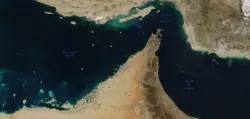
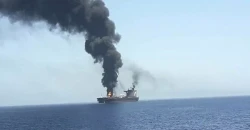
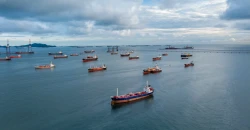
For Iraq, the most direct signal came at sea. A cargo ship was struck by a projectile roughly 52 kilometers southeast of al-Faw, at the mouth of the corridor through which almost all of Iraq's crude reaches the world. Iraq exports the bulk of its oil through the northern Gulf and the Strait of Hormuz.
Traffic through the strait has thinned to around ten commodity vessels a day over the past ten days, its lowest in months, and Mohsen Rezaei, secretary of Iran's Supreme National Security Council, has announced a restricted maritime zone in which ships entering without permission may face Iranian penalties. A prolonged squeeze on those lanes reaches Iraqi state finances directly, since federal revenue and the stability of export routes both hinge on the security of the Gulf.
Baghdad's room to maneuver is narrow in both directions. Prime Minister Ali al-Zaidi, whose government rests on the Shia political forces closest to Tehran, has warned that factions refusing to disarm will face terrorism charges and reaffirmed that foreign forces will leave by October 1. Washington has pressed him hard: after a drone struck a US diplomatic facility in Baghdad, the State Department summoned Iraq's ambassador and publicly faulted Baghdad for failing to prevent the attacks. Tehran has pushed the other way.
Read more: US pressure cannot halt Iraq-Iran trade, expert says
Esmail Qaani, commander of Iran's Quds Force, the arm of the Revolutionary Guard that manages relations with allied groups abroad, visited Baghdad seeking an arrangement that would let the factions retain, or merely freeze, their weapons rather than surrender them. The Badr Organization, among the oldest of those groups, has warned that forced disarmament could open the door to internal strife.
The deeper problem for Iraq is that the war it is exposed to shows no sign of ending quickly. Saleh al-Qazwini, a political analyst who follows Iranian and regional affairs, told Shafaq News that Western forecasts of Iranian collapse misread the picture: inflation and a falling currency are real, but the state's security and political institutions remain intact, and decisions taken at the top by the Supreme National Security Council or the Supreme Leader still hold.
Mahdi Azizi, an expert on Iranian affairs, made a complementary point, arguing that “economic pain has not pushed Tehran toward surrender” and that time may work against Washington as the cost of a long war mounts. “If both readings are correct, the exchange grinds on.”
Akka expects intermittent fighting of low to medium intensity, limited air strikes, attacks on ships and energy infrastructure, cyber and intelligence operations, and the activation of allied groups across the region, a scenario he judges more dangerous than a short, sharp conflict precisely because it leaves no clear line between war and peace. For Iraq, months of that ambiguity mean months in which a single faction's strike on a US target could invite a response on Iraqi soil, and in which the disarmament deadline functions less as a resolution than as a test Baghdad can neither afford to fail nor fully pass.
Al-Zaidi's task is to take the factions' weapons without triggering the internal conflict they have threatened, and to do it while a live regional war hands those same factions their strongest argument in years for keeping them.
Read more: Tension meets dialogue as Iraq approaches September 30
Written and edited by Shafaq News staff.