From boom to bust: What's behind Iraq's Real Estate downturn?


Shafaq News/ Iraq’s real estate market has slowed considerably over recent months, with lower housing demand, fewer sales, and stagnant prices spreading across the capital and beyond. Industry professionals and economists point to a mixture of financial, regulatory, and political challenges that have cooled down what was once a bustling sector.
In conversations with Shafaq News, multiple experts linked the slowdown to the 2025 federal budget delay, new restrictions on property purchases, and declining oil revenues, a combination that has squeezed liquidity, dampened investor enthusiasm, and disrupted transactions across the board.
Budget Uncertainty
One of the most cited factors behind the downturn is the postponement of the 2025 budget bill. With infrastructure spending and housing support projects in limbo, many private investors and buyers are holding back, awaiting clearer signals from the government.
Economic analyst Ahmad Abdul Rabeh views the delay as disruptive to real estate momentum, especially for the developments dependent on public financing. Speaking to Shafaq News, he connected the lack of budget clarity to growing market hesitation and reduced construction activity.
“The slowdown has also been amplified by volatility in global crude prices. Brent crude is now trading around $60 per barrel, significantly below Iraq’s 75$ fiscal projection benchmarks, weakening the country’s financial position and straining expectations tied to state-led development, including housing,” he explained,
Compounding the uncertainty are recent banking measures requiring that all property sales above 100 million Iraqi dinars (about $68 thousand) be processed through official bank channels. The Central Bank of Iraq introduced the regulation to improve oversight and reduce the risks of money laundering, but its impact on real estate activity has been immediate.
Abdul Rabeh observed that many citizens remain wary of placing large sums in banks. “There’s still a level of mistrust. People fear delays, complications, or worse, the inability to access their money in a crisis.”
Initially, the mandatory banking threshold stood at 500 million dinars (about $341 thousand) in 2022 before gradually being lowered. It now affects a wide swath of mid-range and even modest property sales.
Officials defending the policy maintain it was carefully crafted. An expert from the Anti-Money Laundering and Counter-Terrorism Financing Office shared that the measure followed two years of field studies and was consistent with global practices. “We designed the rule to reflect our environment while aligning with international financial standards,” the official clarified.
From the perspective of Iraq’s banking institutions, transparency remains the driving force. Ali Tariq, who heads the Iraqi Private Banks League, emphasized the importance of income-source verification. In remarks to Shafaq News, he pointed out that when an individual with limited monthly earnings attempts to purchase a property worth 100 million dinars or more, questions must be asked. “These steps are about protecting the system and ensuring transactions are legitimate.”
Demand Dips, Inventory Grows
According to economist Nasser al-Kinani, the dynamic that had long fuelled Baghdad’s property boom has flipped. “For several years, demand sharply outpaced supply, allowing prices to surge,” he observed during an exchange with Shafaq News. “Now that dynamic has reversed. There are more sellers than buyers, and that has flattened price growth, even reversed it in some districts.”
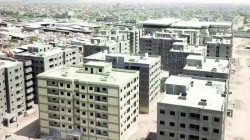
In many areas of the capital, homes that once commanded $5,000 per square meter now sit with no offers or face bids well below expectations. The market imbalance isn’t just theoretical, it’s reshaping livelihoods.
Construction activity, often a reliable source of daily income for many, has slowed dramatically. Nazar Hammadi, a 35-year-old laborer from al-Furat, has been struggling to find work. “In the last two months, I’ve barely worked. Only a few days here and there,” he shared. Even the WhatsApp groups once used to find gigs have fallen silent.
Ali Saadoun, 22, from Hayy al-Jihad, described a similar pattern. “Things are quiet everywhere. A lot of us just wait, but the calls don’t come.”
Those operating in real estate itself are feeling the freeze. Karim al-Lami, who runs an office in Baghdad, noted that his business has slowed to a near standstill. Client interest has dropped sharply. Transactions now are mostly limited to properties valued under 100 million dinars, largely to sidestep the increasingly unpopular banking procedures. “But even those are rare,” he added.
One major sticking point lies in the length and complexity of the official process. Completing a real estate transaction through the banking system can drag on for years, discouraging both buyers and sellers. The delays, paperwork, and uncertainty have introduced new risks into what used to be straightforward deals.
The new banking rules are not just frustrating industry professionals; they’ve also unnerved ordinary Iraqis. Aya Yahya, a Baghdad resident, had reached an agreement with a buyer to sell her home. But after learning that the deal would need to be processed through a bank, she withdrew. “We had agreed on a price, and the buyer was ready. But once I found out about the banking process, I walked away.”
“People remember what happened in Lebanon. No one wants to be stuck like that, unable to touch their money,” she remarked.
Roadmap to Recovery
Iraq’s property sector isn’t only weighed down by sluggish demand or complex banking procedures. Broader geopolitical tensions and unresolved political dynamics are compounding the strain.
Parliamentarian Jamal Kocher highlighted several overlapping pressures during his exchange with Shafaq News. In his view, the downturn stems from more than just economic fatigue. “It’s not just one issue. When you combine security concerns with low oil prices and shrinking capital, the result is predictable: a contraction in housing activity.”
Investors, he explained, are increasingly hesitant, not just because of budget delays or red tape, but because of the underlying instability that stretches from Baghdad to regional fault lines.
With confidence faltering, voices like Abdul Rabeh have been calling for policy changes to bring structure and momentum back to the market. Chief among his recommendations is expediting the passage of the federal budget, which many believe would unlock stalled projects and boost liquidity.
He’s also pushing for a government-led initiative to make homeownership more accessible, starting with reduced interest rates and targeted investment incentives. The private sector, in his view, needs a stronger signal from the state that housing development is a national priority.
Among his more technical proposals is the rollout of a centralized, digital property information system. This platform could serve multiple purposes such as increasing transparency, helping buyers and developers make informed decisions, and curbing speculative activity that tends to inflate prices without contributing real value.
To anchor these reforms, Rabeh envisions the formation of a joint task force uniting the Central Bank, the Ministry of Finance, and the National Investment Commission. Such coordination, he argues, is critical for aligning housing policies with Iraq’s broader economic strategy.
Nevertheless, until meaningful reforms take shape, many buyers and sellers are expected to continue navigating around formal channels, structuring deals below the 100-million-dinar threshold simply to avoid banking requirements.