Exclusive: Kurdistan seeks firmer US guarantees amid shifting regional dynamics


Shafaq News
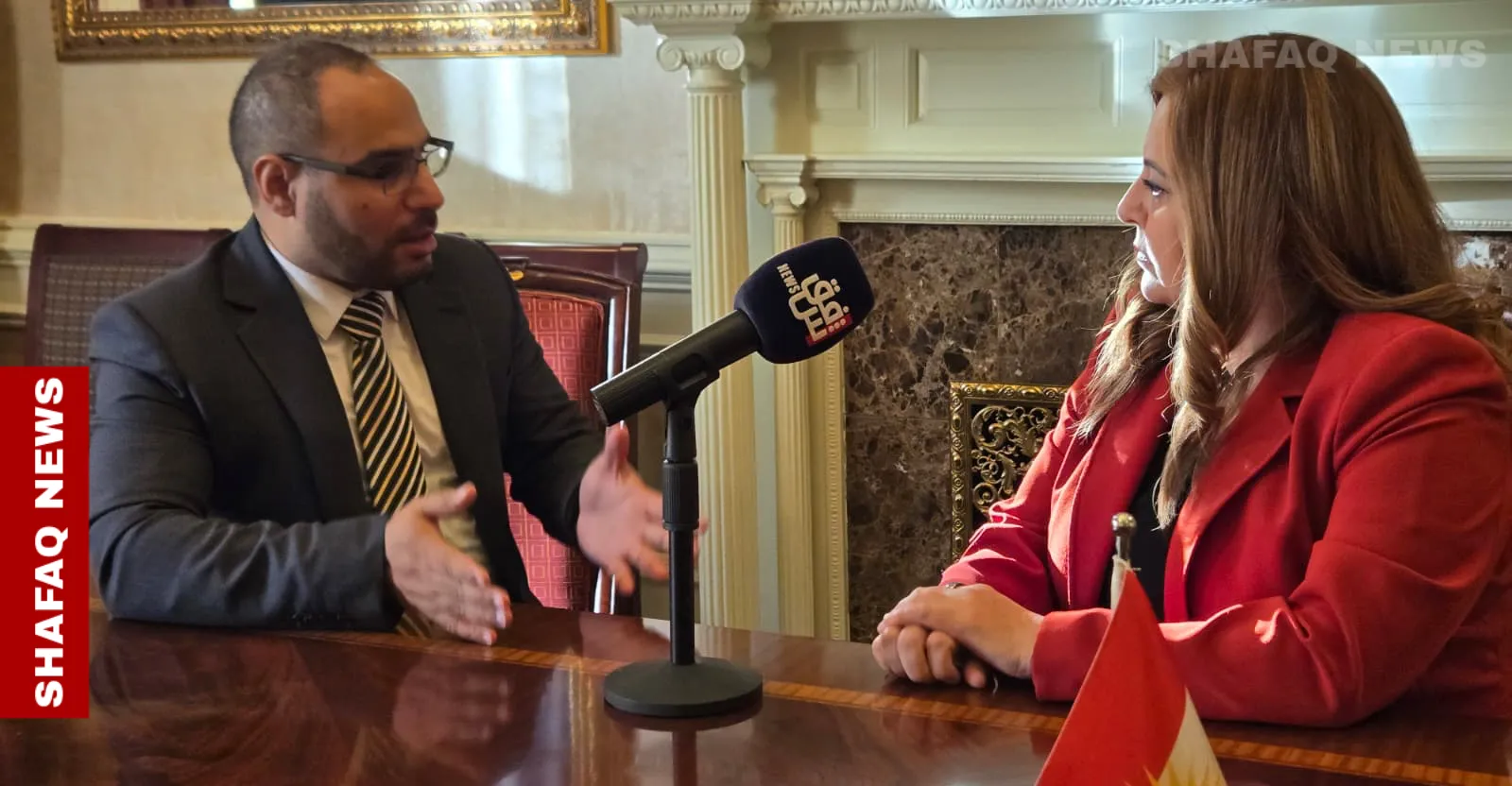
KRG Representative to the United States Tareefa Aziz said the Kurdistan Region’s strategic position in Washington remains solid under the Trump administration.
In an exclusive interview with Shafaq News, Aziz addressed the Kurdistan Region’s standing in Washington, the significance of the new US consulate, the impact of Envoy Mark Savaya’s appointment, ongoing security pressures such as the Khor Mor attacks, and the trajectory of US–KRG economic and strategic ties.
The following is the full text of the interview:
Q: How would you assess the Kurdistan Region’s standing in Washington today—specifically with the Trump administration—given the growing discourse on realigning US Middle East priorities toward energy and security over other issues?
R: The Kurdistan Region’s standing in Washington remains exceptionally strong. The Trump administration has made clear that peace, stability, and economic expansion in the Middle East are central priorities, and the KRG is fully aligned with those goals. Our relationship is decades-old, strategic, and rooted in trust. Recent events, including the opening of the largest US consulate in the world in Erbil, demonstrate that Washington sees the Kurdistan Region as a long-term and reliable partner at a time when energy security and regional stability matter more than ever.
Q: Discussions on relations with Washington often refer to a "360-degree strategic partnership" encompassing security, economy, and diplomacy. In practical terms, what are the pillars of this partnership today across Congress, the White House, and the State Department?
R: The US –Kurdistan partnership today is grounded in strong engagement with Congress, the White House, the State Department, and across other US agencies centered on security cooperation, expanding economic ties, and active diplomatic outreach. We continue to maintain a steady presence on Capitol Hill and in our engagements with the administration, ensuring that our priorities remain well understood and that this long-standing, reliable partnership continues to deepen across all areas.
Q: The US is constructing a massive consulate compound in Erbil, described as the largest US consulate in the world—larger even than many embassies. How do you interpret this message? Does it signify that Washington views Erbil as a long-term center of gravity in the region, rather than merely a transient outpost?
R: The opening of the new US consulate reflects America’s long-term commitment and the important strategic partnership that the Kurdistan Region has with the United States. It is a clear vote of confidence in the Kurdistan Region, its stability, and its future. The facility will serve as a strategic hub for engagement across Iraq and the wider region, deepening cooperation on counterterrorism, investment, energy, economic development, and people-to-people ties.
Q: The appointment of Mark Savaya—a Chaldean-Iraqi-American businessman from the medical cannabis sector—as Special Envoy to Iraq has sparked controversy, yet it was presented in Washington as a signal to revitalize relations with Baghdad and Erbil during a turbulent regional moment. In your view, what does this selection imply for the future of Iraqi- US relations? Do you see it as an opportunity that could serve the Kurds, or a new risk driven more by personality than by an institutional diplomatic track?
R: The Kurdistan Regional Government looks forward to working with the Mr. Savaya in his new role as US Special Envoy to Iraq. His appointment underscores the importance the Trump administration places on Iraq and the Kurdistan Region. Any senior-level attention from Washington is an opportunity to strengthen ties. The KRG sees Envoy Savaya’s role as a chance to advance institutional cooperation, support stability, and reinforce long-standing US priorities in Iraq.
Q: Envoy Mark Savaya has spoken on multiple occasions about the necessity of "consolidating weapons under state control" and implementing "fundamental reforms" in Iraq's governance and economy, while pledging continued US security support. What do you practically expect from his role specifically regarding Kurdistan? Do you anticipate greater pressure on Baghdad regarding energy files, salaries, and protecting the Region from attacks, or rather mediation to rebuild trust between Baghdad, Erbil, and Washington within a new governance equation?
R: We expect the Envoy to support practical solutions between Baghdad, Erbil, and Washington, particularly on key issues such as energy security, budget stability, the protection of critical infrastructure, as well as addressing challenges for the long-term stability of the country. His early statements have emphasized consolidating weapons under state authority and reform, which aligns with our own interests. We hope he will help expedite defensive equipment, including urgently needed anti-drone systems to the Kurdistan Region.
Q: For years, Washington has described Kurdistan as its "closest, most reliable partner" in Iraq. Do you feel this description remains accurate given the growing influence of Iran-aligned factions in Baghdad and the ongoing debate regarding the future of the US military presence in Iraq?
R: The Kurdistan Region remains the most reliable US partner in the region. This partnership has been tried and tested through decades of cooperation, from the fight against ISIS to supporting American investments and regional stability. Despite shifts in Baghdad’s political landscape, the US consistently affirms that the Kurdistan Region remains its most reliable partner in Iraq, and a linchpin of its foreign policy in Iraq.
Q: Recent security agreements outline a shift of US forces from bases in central and southern Iraq to a more significant concentration in Kurdistan. Do you view this as reinforcing the Region’s status as a key security partner for Washington, or does it place an additional security and political burden on the KRG in confronting Iran-aligned factions?
R: The Kurdistan Region remains fully committed to counterterrorism cooperation and regional stability. If the US sees the Kurdistan Region as a key security partner, that reflects our long-standing commitment and the stability we provide within Iraq.
Q: How do you interpret the political message behind the Khor Mor attacks on one hand, and KRG Prime Minister Masrour Barzani’s request for air defense systems on the other—and will Washington respond to this request? Furthermore, who is the actual beneficiary of targeting a facility that serves as an energy nerve center for both the Region and Iraq?
R: The attack on Khor Mor was a direct strike on the energy security of both the Kurdistan Region and Iraq. Prime Minister Masrour Barzani’s request for anti-drone systems reflects the severity of the escalating threat. The US responded swiftly in condemning the attack, but we have been clear: condemnations must be paired with action. These facilities power millions of innocent civilians. The beneficiaries of such attacks are actors who wish to destabilize Iraq and undermine American and regional interests.
Q: Do you fear that Khor Mor and other gas fields could turn into a permanent "pressure point" used by armed groups to blackmail Erbil, or perhaps to exert pressure on Washington and American energy companies operating in the Region?
R: Unfortunately, oil and gas fields in the Kurdistan Region have been consistently and repeatedly attacked. Any attack on energy infrastructure hurts all of Iraq. That is why it is essential that these facilities are protected. We are working closely with Baghdad and Washington to ensure such sites are not used as leverage by illegal armed groups seeking to destabilize the region.
Q: During Prime Minister Masrour Barzani’s last visit to Washington, major energy agreements with US companies were announced, with values estimated at $100–110 billion over the lifespan of the contracts. How do you assess the importance of these contracts for Kurdistan and their role in US policy?
R: These long-term contracts with major American companies are a cornerstone of our economic partnership with the United States. They signal strong investor confidence, support regional energy security, and contribute directly to Iraq’s stability. For US policy, these agreements represent a deep, strategic American presence in one of the Middle East’s most promising energy markets.
Q: Does your office in Washington have a clear economic roadmap for the next three years to attract US companies, or is the role limited to facilitating meetings and delegations? Additionally, how do you measure success: by the volume of investments, or by the quality of projects and technology transfer?
R: Our office is actively advancing a forward-looking economic agenda. We work to attract high-quality, high-impact American investment while supporting trade delegations, networking, and policymaker engagement. Success is measured not only through investment volume but through durable partnerships, technology transfer, and the modernization of key sectors such as energy, digital transformation, and agriculture.
Q: How do you navigate dealing with two nearly contradictory lobbies in the US capital: one advocating for reduced engagement in the Middle East and withdrawal from Iraq, and another arguing that maintaining a strong, allied Kurdistan is a long-term strategic investment for the United States?
R: Washington is a place of diverse and competing viewpoints. Fortunately, we have maintained strong bipartisan support in the United Stated Congress for decades. Our message is consistent: a strong and stable Kurdistan Region benefits both Iraq and longstanding US interests. We focus on facts, on the KRG’s record as a reliable partner, and on the tangible contributions the Region makes to security and energy stability.
Q: Internally, how do you assess the Kurdish landscape itself: the partisan divisions, the stalled government formation in the Region, and the disputes between Erbil and Sulaymaniyah? Does this image weaken Kurdistan’s ability in Washington to advocate for a unified and clear cause?
R: Political debate exists in every democratic society. The Kurdistan Region remains committed to stability, unity, and good governance. What matters most to our partners in Washington is our continued reliability, our ability to provide security, and our consistent alignment with shared US Iraq goals. These fundamentals have not changed.
Q: As a Kurd holding the position of KRG Representative in the United States, how do you leverage this identity to understand the "language of Washington" on one hand, and to convey the concerns of the Kurdish street on the other?
R: As a Kurdish American with two decades of experience in foreign and legislative policy, I’m in a unique position to bridge both worlds. My background helps me understand how Washington thinks — its policy language, strategic priorities, and decision-making culture — and it allows me to communicate our government’s goals and mission effectively. At the same time, I stay grounded in the values and expectations of our people, so I can reflect their concerns accurately and advocate for their them with credibility.
Q: If you were asked to summarize the Kurds’ message to decision-makers in Washington in a single sentence—following the Khor Mor attacks and all the recent economic and political crises—what would that sentence be?
R: As the most reliable and trusted ally of the United States, the Kurdistan Region needs reliable political and security support from the United States so we can protect our people, stabilize our economy, and remain a trusted partner in an increasingly dangerous environment.
Q: Finally, when you look at the next five years, do you feel that Kurdistan is heading toward greater stability and a deeper partnership with Washington, or do the surrounding risks (regional and internal) outweigh the opportunities for growth? And why?
R: We remain optimistic. With sustained US engagement, expanding economic partnerships, and progress on defensive capabilities, the Kurdistan Region is well-positioned for deeper stability and growth. The challenges we face are real, but so are the opportunities, and with strong partnerships, particularly with the United States, we believe the next five years can be a period of greater security, expanded investment, and long-term stability.
For Shafaq News, Mostafa Hashem, Washington D.C.