Death in the current: Pollution decimates Iraq’s river ecosystems


Shafaq News
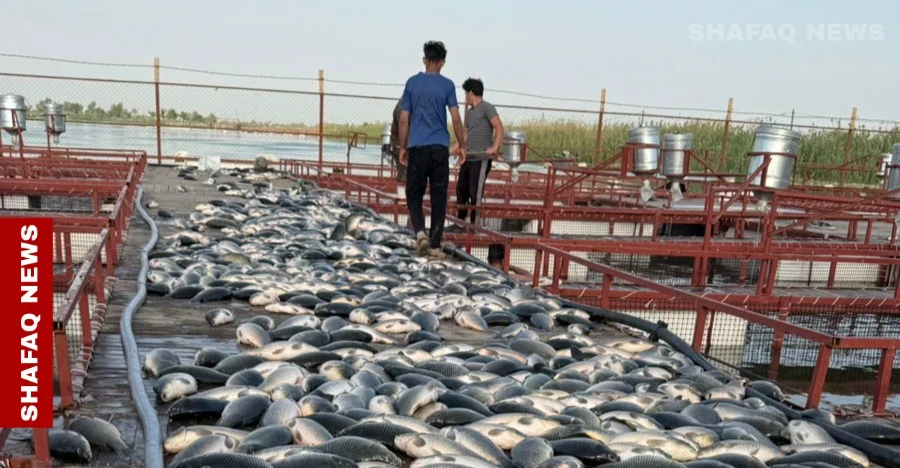
A mass fish die-off along the Tigris River in Wasit province, 180 kilometers southeast of Baghdad, has left millions of fish dead and livelihoods shattered —exposing a widening environmental and regulatory crisis across Iraq’s river systems. While the immediate losses remain concentrated in floating cages in Kut, al-Aziziyah, and Numaniyah, the scale of the disaster points to upstream contamination, long-standing failures in water governance, and a broader ecological breakdown spanning multiple provinces.
Fish farmers report thousands of tons of losses as untreated sewage, industrial discharge, declining water levels, and years of accumulated pressure on waterways converge into a single destructive episode.
At the hydrological level, the Tigris–Diyala system operates as a single interconnected pollution corridor. Contamination introduced upstream does not remain contained within administrative borders; it moves across provinces, carried by seasonal flow variations, rainfall surges, and regulated water releases —expanding the impact far beyond its original point of origin.
Sudden Aquatic Ruin
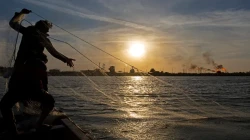
For Rasool Karim Ali, executive director of the Al-Baraka fish farming project in Wasit, the collapse came without warning. “This is not just a scene; it is a tragedy that breaks the heart,” Ali recalled in an interview with Shafaq News. “We woke up expecting a normal working day, only to find our livelihood, built over years, dying before our eyes.”
What unfolded in those hours was not an isolated incident, but the visible outcome of deeper, long-unresolved structural failures. Ali pointed to contaminated, slow-moving water “loaded with toxins” that had been left untreated in the Diyala River before being released into the Tigris.
“We were only asking for a lawful livelihood, but in a moment, due to deadly negligence, everything turned into mass death,” he continued, describing how the discharge triggered a disaster that wiped out thousands of tons of fish.
At such levels, fish mortality is rarely random. It typically occurs when oxygen levels fall below biological survival thresholds, when sudden spikes in ammonia or sulfides overwhelm aquatic systems, or when heavy metal toxicity exceeds tolerance limits. Yet despite these possibilities, no publicly released laboratory data has clarified which threshold was ultimately breached.
According to Iyad al-Talibi, head of the Iraqi Association of Fish Producers, the trigger began days earlier in the Diyala River. “Four days earlier, there was a leakage of sewage water in the Diyala River,” al-Talibi explained. “These waters had accumulated over years and came from northern areas quickly, stirring up sediments and sharply increasing pollution.”
Compounding the situation, seasonal rainfall upstream likely intensified the crisis. Such conditions can re-suspend riverbed sediments containing decades of industrial and municipal waste —a process known as “legacy pollutant remobilization”— suddenly reintroducing buried toxins into the water column.
From there, the contaminated flow moved into the Tigris north of Kut, spreading rapidly across fish farming zones. For farmers like Ali, the consequences were immediate and devastating. Al-Talibi estimates that around 95% of floating cages in Kut were affected, with nationwide losses ranging between 1,000 and 1,200 tons of fish.
“The dead fish include carp and grass carp, and virtually all aquatic life,” he added.
Market Under Siege
As the die-off spread, its economic repercussions were already taking shape in a sector under growing strain. The Iraqi fish market is currently experiencing an unprecedented downturn following government campaigns to remove unauthorized farms that once supplied large volumes to local markets. Prices have dropped to around 4,500 Iraqi dinars ($3) per kilogram, while production costs remain near 6,000 dinars ($4), placing farmers in direct and unsustainable loss.
This inversion —where production costs exceed market price— signals a structurally unviable sector, often preceding large-scale withdrawal from production. Pressure is expected to intensify further. A seasonal shock is looming with the spread of a deadly herpes virus capable of killing up to 80% of fish stock. To avoid catastrophic losses, farmers often rush to sell before October, flooding the market and driving prices down even further.
Globally, such outbreaks intensify under stress conditions, particularly during temperature shifts between summer and winter, in oxygen-poor waters, and in systems with high stocking density —all conditions increasingly present across Iraq’s aquaculture sector.
Despite the scale of the threat, authorities have yet to address the herpes virus crisis, with no vaccine available and no clear mitigation strategy in place.
Flowing Toward Collapse
Beyond immediate losses, the incident exposes a deeper imbalance in water use and regulation. Data from the Center for Strategic and International Studies (CSIS) shows that fish farming expansion in Iraq has accelerated rapidly and largely without control. Unauthorized farms grew from nearly 2,000 between 2014 and 2017 to more than 5,000 in 2023, far exceeding the government’s sectoral limit of 330 million cubic meters.
These operations now consume around 2 billion cubic meters of water annually —double Jordan’s entire yearly supply— while contributing to the shrinking of natural water bodies such as Lake Habbaniyah. At this scale, water extraction is no longer a neutral process. It alters river flow regimes, reduces the natural dilution of pollutants, and concentrates contaminants in slower-moving sections of the river.
Toxins without Borders
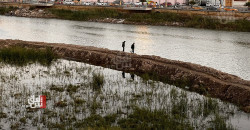
Field evidence indicates that the contamination affecting Wasit is not an isolated occurrence, but part of a wider and interconnected pollution network. According to Amer Shafiq al-Hamdani, deputy head of Iraq’s veterinarians’ syndicate, polluted waters originate in northern regions, including the Zagros mountain areas, before passing through Khanaqin and Muqdadiya via the Diyala River, finally merging with the Tigris north of Kut.
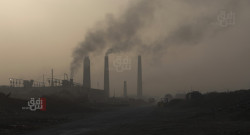
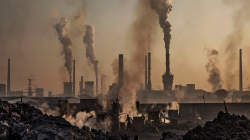
Along this path, the water accumulates untreated sewage, medical waste, industrial discharge, heavy metals, and scrap materials, steadily increasing its toxic load as it moves downstream. Environmental chemistry further explains this accumulation. Heavy metals bind to sediments and are later released under acidic or oxygen-poor conditions, accelerating oxygen depletion, while stagnant flow concentrates pollutants even further.
Al-Hamdani identified al-Rustumiya area southeast of Baghdad as a major discharge point, where untreated waste continues to enter the Diyala River. In addition, regulated water releases by the Ministry of Water Resources have contributed to pushing contaminants downstream toward Kut, expanding rather than containing the pollution footprint.
What unfolded in Wasit mirrors a broader and increasingly documented national pattern. In Babil province, large numbers of dead fish were found in the Yahudiya River, where residents reported tanker trucks dumping wastewater at night into already stagnant and visibly polluted waters.
In June, thousands of fish died in the Ibn Najm Marsh, which spans Najaf, Babil, and Al-Diwaniyah. A technical assessment by the Najaf Environment Directorate confirmed that a sharp drop in dissolved oxygen triggered the collapse.
The marsh system —spanning three provinces— has repeatedly been described in local reports as an “escalating environmental emergency,” with oxygen depletion emerging as a recurring structural failure rather than an isolated event.
Such incidents tend to cluster under specific conditions: during low-flow seasons, periods of high temperatures, or when critical infrastructure such as pumping stations fails —conditions that are becoming increasingly frequent across Iraq’s water systems.
Poisoned Public Silence
The consequences extend beyond environmental and economic losses into long-term public health risks. “These elements are not properly metabolized by fish, and when consumed, they can transfer to humans,” al-Hamdani warned, referring to heavy metals such as lead and cadmium.
“Their effects may not appear immediately but after months or years.”
Even low-level exposure to such metals can accumulate in human tissue over time, affecting neurological and renal systems. Rainfall further complicates this cycle, dissolving toxic elements into soil before reintroducing them into river systems, creating a continuous loop of environmental contamination.
“If sewage contamination is confirmed, these fish should not be consumed because they are dangerous to public health,” he cautioned.
Despite repeated incidents across multiple provinces, environmental governance continues to face critical gaps in monitoring, weak enforcement of discharge regulations, and limited public disclosure of water quality data.
What remains unresolved is not only the precise cause of the Wasit fish die-off, but whether it marks another isolated shock —or a clear and irreversible rupture in a system already under years of visible, cumulative strain.
Written and edited by Shafaq News staff.