Classroom to street corner: Degree holders stranded in Iraq's job drought


Shafaq News
Each year, roughly 200,000 Iraqis complete university and technical education, believing their qualifications will secure them stable employment. Instead, many enter a labor market struggling to keep pace with the growing number of graduates, leaving thousands unable to find work despite their degrees.
For a new generation of Iraqis, graduation no longer marks the start of professional life. It often signals the beginning of an uncertain search for work, with many competing for a shrinking pool of government jobs, accepting positions unrelated to their qualifications, or looking abroad for opportunities.
The pressure continues to mount in a country whose population is approaching 47 million, according to World Bank estimates, while hundreds of thousands of young Iraqis reach working age each year.
Absorbing that expanding workforce has become one of Iraq's biggest economic challenges. Although oil generates about 90% to 95% of government revenue, the sector creates relatively few jobs compared with its outsized role in the economy.
That imbalance has also narrowed the state's ability to remain the employer of last resort. Around 70% of public spending is allocated to salaries and wages, according to Ministry of Finance data, leaving limited fiscal space to expand government hiring or invest heavily in sectors capable of generating jobs on a larger scale.
For decades, public-sector employment offered Iraqi graduates the clearest path to financial stability. Government jobs provided better pay, stronger benefits, and greater security than much of the private sector. But as state payrolls expanded and fiscal pressures intensified, that pathway steadily narrowed, forcing a growing number of graduates to compete for fewer positions.
Universities, meanwhile, have continued producing ever-larger graduating classes.
Over the past two decades, Iraq has significantly expanded access to higher education, opening universities and technical institutes across the country. Ministry of Higher Education data from the 2024–25 academic year illustrate the scale of that expansion, with more than 52,000 students admitted to education and basic education programs, 29,160 to science, 25,076 to administration and economics, and 21,047 to engineering, while medicine, dentistry, and pharmacy together enrolled more than 9,300 students. Yet many graduates continue to set their sights on public-sector employment because private companies remain too small to absorb the country's growing pool of job seekers.
The imbalance extends beyond the rising number of graduates. Economists point to a widening disconnect between what universities produce and what Iraq's economy actually needs.
"Iraq's efforts to reduce dependence on oil require stronger manufacturing, technology, and service industries, but these sectors have not expanded quickly enough to create enough positions for the country's growing workforce," economic expert Mudher Saleh told Shafaq News, adding that a university degree remains highly valued socially, but for many young Iraqis it no longer guarantees a clear career path.
Read more: New path to jobs: Iraq’s shift toward vocational education
Crude but Jobless
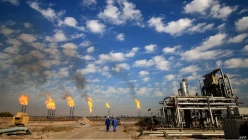
Despite holding some of the world’s largest oil reserves and generating billions of dollars from crude exports, Iraq’s petroleum sector is highly capital-intensive. It provides substantial government revenue but cannot absorb the hundreds of thousands of people joining the labor market every year.
The World Bank and the International Monetary Fund (IMF) have repeatedly pointed to Iraq’s dependence on oil, weak private-sector development and limited job creation as among the country’s most pressing structural economic challenges.
The strain is reflected in the labor market. Iraq’s Ministry of Planning estimated unemployment at around 13% in 2025, while other estimates placed it at 15.5% during the first half of 2026. Youth unemployment remains considerably higher, ranging between 28% and 32%, placing Iraq among the countries with the highest youth unemployment rates in the region.
International economist Nawar al-Saadi attributed Iraq’s unemployment crisis to a combination of economic, administrative and political failures rather than a single underlying cause.
“Iraq possesses significant financial, natural and human resources, but many institutions continue to operate under a quota-based system rather than standards of competence and achievement,” al-Saadi informed Shafaq News. He maintained that this approach has slowed development projects, weakened economic planning and discouraged investment opportunities capable of generating thousands of jobs.
The consequences extend well beyond economic indicators.
Economic expert Ziad al-Hashemi stressed that successive Iraqi governments have failed to establish stable economic institutions, create an investment climate attractive to businesses or develop legislation capable of encouraging investment and diversifying the economy.
“Political parties bear a significant share of the responsibility after turning ministries, government agencies and state-owned companies into areas of influence and sources of financial gain,” he told Shafaq News, arguing that this has expanded public-sector employment beyond sustainable levels.
Read more: Youth in despair, no jobs to share: Iraq’s workforce hanging in the air
Protest over Payroll
For many young Iraqis, unemployment has evolved from an economic challenge into a recurring source of public frustration.
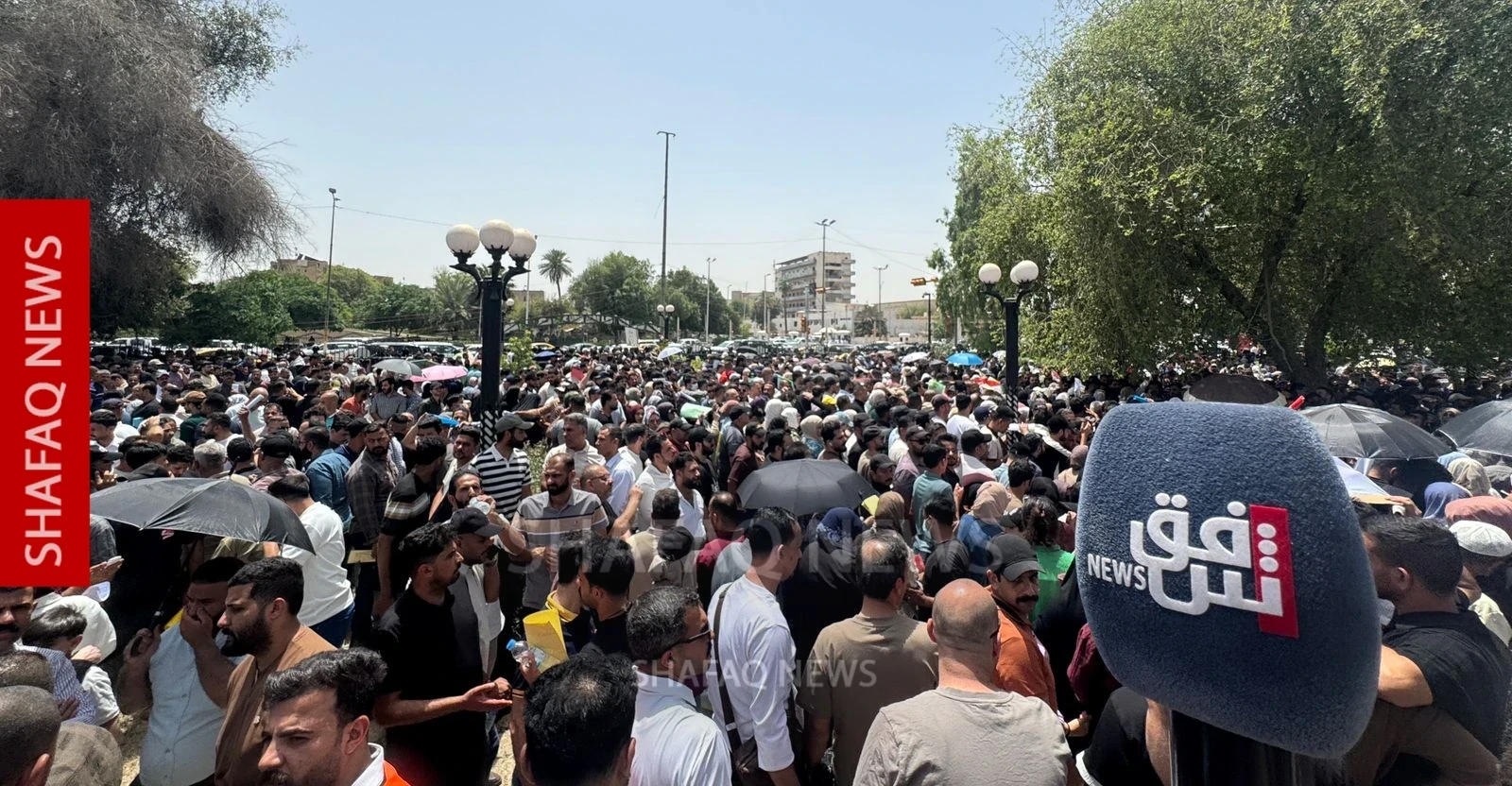
Across Baghdad and provinces including Dhi Qar, Basra, Maysan, Najaf and other southern provinces, unemployed graduates have repeatedly taken to the streets to demand government hiring, recruitment opportunities and practical solutions after years of searching for work.
Gatherings outside ministries, provincial administrations and other government institutions have become a familiar feature of Iraq’s public life, reflecting growing frustration among graduates who see few pathways into stable employment.
The issue also stood at the center of the 2019 Tishreen anti-government protests, when thousands of young Iraqis pointed to unemployment, corruption and deteriorating public services as among the main drivers of their anger.
The demonstrations did not end with the Tishreen movement. Graduate protests persisted in the years that followed, including throughout 2025 and 2026, as each new wave of university graduates joined a labor market where opportunities remained far below demand.
Read more: Iraq’s protests after Tishreen: A system that learned how to contain the street
Missing Engine
Successive Iraqi governments have repeatedly presented private-sector growth as the long-term answer to the country’s employment challenge. For many economists, however, the sector remains too small, too reliant on public spending and too underdeveloped to absorb the hundreds of thousands of Iraqis entering the labor market each year.
The IMF reached a similar conclusion in its 2025 report, pointing to weak private-sector development as one of Iraq’s main structural economic challenges and warning that limited economic diversification has left the country heavily dependent on public employment and oil revenues.
Much of the problem lies in the private sector’s relationship with the state. Many businesses continue to rely heavily on government contracts and public expenditure, limiting their ability to expand independently and generate large numbers of sustainable jobs.
Mohammed al-Najjar, executive director of the Iraq Development Fund, acknowledged that private companies have created employment opportunities but maintained that much of that growth remains tied to government-funded projects and state spending.
“The private sector’s ability to generate more jobs will remain limited unless legislative reforms allow businesses to operate more independently,” he conveyed to Shafaq News.
Recognizing those constraints, the government has introduced several initiatives aimed at narrowing the gap between education and employment. Under its “Iraq 2050” vision, Baghdad seeks to reduce its reliance on oil while strengthening productive sectors and expanding the private sector’s role in the economy.
The Ministry of Labor and Social Affairs has also expanded vocational training programs while promoting the establishment of a Higher Council for Training to improve coordination between educational institutions and labor-market needs.
Al-Najjar, however, maintained that training alone will not resolve the employment crisis unless Iraq also develops industries and businesses capable of absorbing those newly acquired skills.
“Without broader economic diversification, stronger private-sector growth and reforms that create space for investment and job creation, Iraq’s graduate boom will continue to outpace the country’s ability to provide employment,” he stated.
In his view, the shortage of jobs facing Iraqi graduates reflects a broader challenge that has shaped Iraq’s economy for years: attracting enough investment to build industries, expand businesses and generate employment on a meaningful scale.
Former deputy head of Parliament’s Investment Committee, Suzan Mansour, shared a similar assessment, arguing that Iraq’s investment priorities have often favored housing developments over productive industries capable of strengthening the economy and expanding employment opportunities.
Urging the National Investment Commission to redirect investment toward projects that increase production, generate jobs, and deliver stronger economic returns, she noted that Iraq continues to import a large share of its food and consumer goods even as farmers struggle with rising production costs, limited access to agricultural supplies, and difficulties reaching markets.
Expanding those productive sectors, she added, would not only provide employment opportunities for graduates and young workers but also reduce dependence on imports and establish the foundation for a more diversified economy.
Read more: The rentier trap: Iraq’s existential reform race
Unlocking the Potential
Although Iraq has secured several major energy and infrastructure investments in recent years, a number of high-profile projects have been delayed, suspended, or abandoned, limiting their potential to stimulate economic growth and generate employment.
For international economist Nawar al-Saadi, the impact extends far beyond construction delays or lost investment. Every stalled industrial project, he maintained, represents factories that were never built, businesses that never opened, and jobs that never materialized for a workforce expanding year after year.
“Iraq possesses significant financial, natural, and human resources, but many institutions are operating below the standards needed for competence and achievement,” al-Saadi told Shafaq News, attributing persistent project delays, weak development planning, and missed investment opportunities to poor management and political influence while noting that thousands of potential jobs have been lost as a result.
Several flagship projects illustrate those challenges.
In February 2024, Iraq’s Ministry of Industry and Minerals disclosed that Shell had withdrawn from the Nibras Petrochemicals Project in Basra, which had been planned as one of the largest petrochemical complexes in the Middle East.
The project was expected to produce around 1.8 million metric tons annually and was widely viewed as a major step toward reducing Iraq’s dependence on crude oil exports by developing higher-value industries linked to the country’s energy sector.
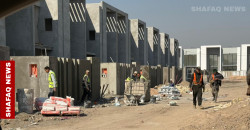
Investment challenges have not been confined to the energy industry. South Korea’s Hanwha Engineering & Construction withdrew from the Bismayah residential city project in 2020 before later returning after reaching new agreements with the Iraqi government over financial and implementation issues.
As Iraq continues to confront the challenge of creating enough opportunities for its growing workforce, thousands of graduates are entering a job market where the path from education to employment remains uncertain. For many, the years spent preparing for a career are followed by a new challenge: finding where their education fits in an economy still searching for balance.
Read more: Deficit soars, projects freeze: Iraq heads into 2026 with NO BUDGET
Written and Edited by Shafaq News Staff.