Acts and unclear legislation: Legal pursuits in Iraq over blasphemy and “immoral content”


Shafaq News
Over the past two years, Iraqi courts and security agencies have pursued dozens of cases against individuals accused of blasphemy or producing “immoral content.”
In July 2024, a Mosul court sentenced a young man to six months in prison for “insulting the divine self” in a video deemed offensive to public taste. Months later, two men in Al-Anbar were arrested during a live broadcast mocking religious sanctities, while a well-known singer in Baghdad was detained for allegedly “defaming the divine” during a performance.
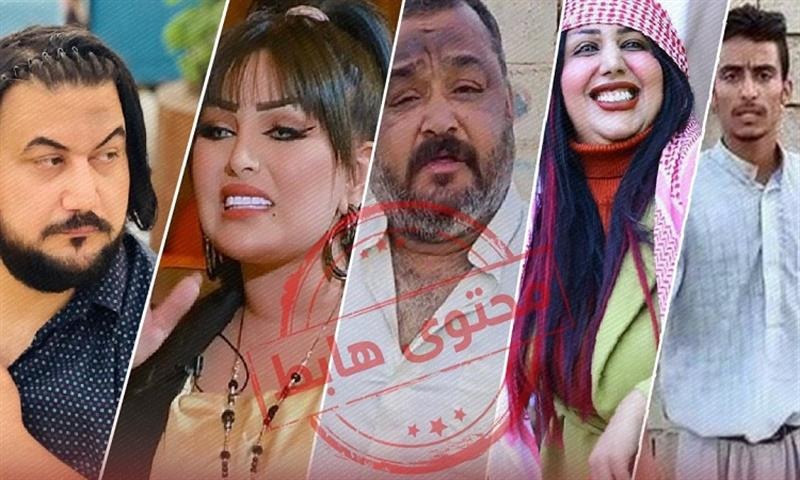
At the same time, prosecutors turned their attention to social media. TikTok influencers such as Ayah al-Shammari and Zainab bint Diwaniyah were summoned for “immoral” videos, a Baghdad blogger was charged after celebrating his wife’s pregnancy by blocking traffic, and Samaraa TV was penalized for “immoral insinuations” in one of its programs.
Even in 2025, prosecutions continued against influencers and public figures accused of insulting the divine or violating public morals. These incidents form only part of a wider campaign that has become a defining feature of Iraq’s legal and social landscape.
Divergent Reactions
The arrests drew mixed responses. Some Iraqis welcomed them as overdue measures against “low content,” and others demanded broader crackdowns on anyone seen as tarnishing Iraq’s reputation. Critics, however, warned that such actions amount to an infringement on personal freedoms, particularly when detainees had not, in their view, insulted Iraqis, state institutions, or religious symbols.
Sheikh Mohammed al-Shammaa, Imam of the Nabi Yunus Mosque in Mosul, told Shafaq News the campaign “represents a proper step to confront producers of indecent content in the city.” He argued that some social media figures “have become famous by spreading misleading and negative impressions about Mosul to audiences in other Iraqi cities.”
Journalist Abdulrahman al-Taie described the arrests as a “warning message” to social media users. He told Shafaq News that combating low content “has become urgent given the decline in ethical behavior and the shocks to social conduct.”
While calling for firm action, he noted that authorities should first issue warnings and clarify legal boundaries to prevent repeated violations on digital platforms.
Lawyer Ahmed al-Sinjari explained that Article 403 of the Penal Code already addresses “immoral” publications that corrupt public taste, but convictions require both a material act and criminal intent. “If one of these elements is absent, courts must dismiss the case,” he said, cautioning against exploiting moral laws to settle political scores. He urged lawmakers to set clearer limits distinguishing genuine obscenity from legitimate opinion or criticism.
Activists voiced stronger criticism. Social media activist Ahmed Zidan told Shafaq News that the arrests serve as “a method of repression and silencing.” He argued that most of those targeted “did not threaten Iraq’s security or social stability,” while more dangerous provocations—such as sectarian incitement, calls for violence, and attacks on state institutions—are often overlooked when linked to powerful parties. “Some influencers and politicians backed by dominant parties spread sectarian strife, especially ahead of elections, to gain political advantage,” he said. “They are more deserving of prosecution than young people chasing fame on social media.”
The Legal Dilemma
Iraq’s Penal Code provides the basis for these prosecutions. Article 372 criminalizes insulting religion or divine entities; Article 403 punishes the distribution of “immoral” materials; and other provisions are sometimes stretched to cover online behavior. Yet none of these articles clarifies where “criticism” ends and “insult” begins, or what exactly counts as “immoral.”
This ambiguity leaves judges with wide discretion. One court may treat satire as a crime, while another dismisses a similar case. Even the Interior Ministry’s recent decision to rebrand its monitoring body—from pursuing “low content” to pursuing “content violating modesty and public morals”—did little to define terms or ease concerns about arbitrary enforcement.
Why It Matters for Iraq
The controversy goes beyond individual acts, whether mocking religion or posting provocative dances. It touches on how Iraq defines the limits of expression in a society where religion, tribal codes, and tradition remain powerful forces.
International indices consistently rank Iraq among the most restrictive Middle Eastern states on freedom of expression. Political elites often frame the protection of sanctities as a national duty, blurring the line between defending faith and curbing dissent. Satire, critical art, and social commentary risk being branded “immoral” under this narrative.
For activists and journalists, the climate has fostered widespread self-censorship. The absence of clear legal standards leaves citizens unsure of what is permissible, eroding trust in both the judiciary and government.
The Contradiction
Iraq’s constitution guarantees freedom of expression. In practice, however, religious sanctities, social traditions, and tribal customs often override these rights. The contradiction between constitutional promises and courtroom prosecutions highlights a deeper structural question: is Iraq governed by codified law, or by shifting moral codes enforced selectively?
Selective enforcement, particularly in an election year, risks politicizing the judiciary. Prosecutions may serve to silence critics while sparing politically connected figures who promote sectarian narratives. For Iraq’s fragile democracy, the ambiguity is not merely a legal gap—it is a test of whether the state can balance respect for tradition with protection of fundamental freedoms.
Written and edited by Shafaq News staff.