Abraham Accords resurface: Trump is selling a new Middle East


Shafaq News
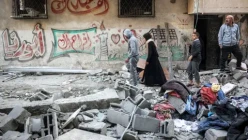
Six years after the Abraham Accords were signed, the framework that was supposed to normalize the Middle East has produced four signatories, stalled at Saudi Arabia, and watched Gaza burn for two years without adding a single significant Arab power.
US President Donald Trump's response, delivered on Truth Social, was to declare the expansion mandatory, encouraging Saudi Arabia, Qatar, Pakistan, Turkiye, Egypt, and Jordan to sign simultaneously as part of any deal with Iran, warning that refusal "shows bad intention." The announcement was addressed to a region that has spent six years demonstrating, through its silence and its conditions, that the framework does not fit the circumstances it was designed to resolve.
The demand triggered a brief silence on a phone call yesterday with the assembled leaders of those countries. Saudi Arabia and Qatar stated that normalization requires an irreversible path to a Palestinian state. Pakistan said it is not committed.
Read more: Trump’s balancing act with Iran tests diplomacy and deterrence
Announcement Nobody Asked For
Haitham Numan, professor of political science at the University of Exeter, told Shafaq News that what is happening is "closer to media and political pressure linked to domestic American considerations, particularly with midterm electoral deadlines approaching," and that the real direction of the region "remains unclear."
Iranian political analyst, Mahdi Azizi, stated to our agency that Trump "is seeking to present an image of political victory domestically, even if it is not achieved on the ground," and that any understanding with Iran "will be used to market an image of restoring American balance in the Middle East, even if it does not radically change the reality."
In an interview with Shafaq News from Ramallah —the territory whose future is the condition the region has set for normalization— Ashraf Akka said the push "reflects complex political pressures inside the United States and Israel more than it reflects genuine regional consensus," and that linking Iran negotiations to a regional reshaping "will not be completed easily because of the complexities of the conflict and the rejection by key parties."
Precondition Trump didn't List
Firas Ilyas, professor of international relations at the University of Mosul, told Shafaq News that what the Trump administration wants is not simply a deal with Iran but "a complete rearrangement of the regional order so that Israel becomes a natural part of the security and economic system of the Middle East," treating the Palestinian question as a variable to be managed rather than a condition to be met.
That project runs directly into what the region's most significant powers have publicly stated. Saudi Arabia and Qatar have both said normalization requires an irreversible path to a Palestinian state —a precondition the Accords framework does not address. Gaza has been at war for more than two years. Lebanon sustained strikes during the regional conflict. Iran has not moved from its core positions despite the ceasefire and ongoing nuclear negotiations. The conditions that would make the Accords expansion viable are further away today than when the original agreements were signed in 2020.
Baghdad's Impossible Position
Iraq did not choose to be the test case for Trump's regional vision. It became one because its internal contradictions mirror the regional ones at the highest resolution; a state that cannot say yes to normalization without triggering a domestic political crisis, and cannot say no without managing pressure from Washington on which its fiscal and security architecture depends.
Read more: Normalization as a RED LINE in Iraq
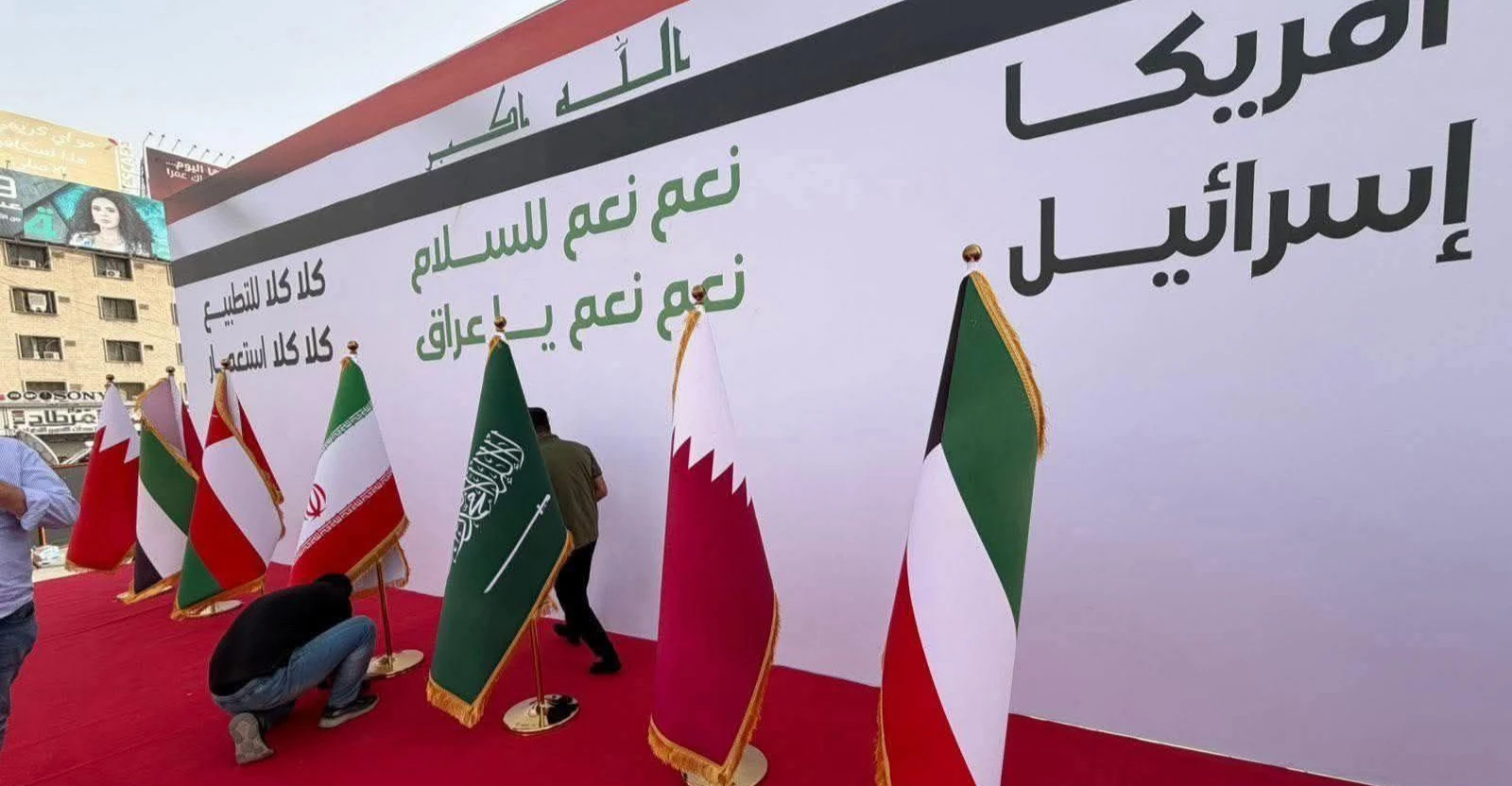
The country has no diplomatic relations with Israel, a 2022 law criminalizing any form of ties with it, and 2025 court sentences for individuals convicted of promoting normalization on social media. Ilyas told Shafaq News that Iraq represents "the most sensitive link" in the proposed transformation precisely because of its internal divisions between forces that reject normalization and those that call for openness.
In December 2025, a statement by Cardinal Louis Raphael Sako mentioning "normalization" triggered an immediate political crisis in Baghdad before anyone confirmed what he meant. The Chaldean Patriarchate was forced to clarify that he had meant internal normalization within Iraq, not any relationship with Israel. The word alone was enough to ignite a storm, and that is the distance between Trump's mandatory framework and the country he is asking to enter it.
Iraqi Politician Mithal al-Alusi, speaking to Shafaq News, locates the problem not in normalization as a concept but in the Accords as a mechanism, "Real peace cannot be immediate deals. It requires direct and mature dialogue between people and states, including Iraq and Israel." The framework is being imposed rather than built, and the transaction being offered does not address the conditions that would give it legitimacy.
Mandatory for Whom
Numan told Shafaq News that the final verdict on this initiative "will become clear after the American midterm elections, when the balance of power within Congress crystallizes," locating the Accords expansion exactly where it belongs: not as a regional peace process with its own internal logic, but as a domestic political project whose durability depends on American electoral outcomes rather than regional conditions.
The Abraham Accords, as Trump has revived them, are a map of a Middle East that does not yet exist. The silence, the stated conditions of Riyadh and Doha, and the criminalization law in Baghdad, all describe the same thing: a region still living inside the conditions the map was drawn to erase, and that has not yet been given a reason to move.
Written and edited by Shafaq News staff.