Israelis vote in first election since October 7 attack


Shafaq News
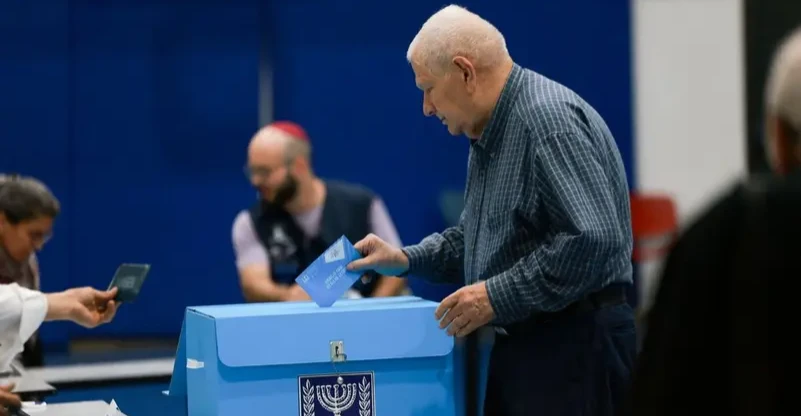
Israelis began voting on Tuesday in their first general election since the Hamas-led attack of October 7, 2023, with Prime Minister Benjamin Netanyahu fighting for political survival against former army chief Gadi Eisenkot in a race that final polls show is too close to call.
About 7.3 million people are eligible to elect the 120-member Knesset, choosing among about 36 party lists at more than 12,000 polling stations, according to the Central Elections Committee. Polls opened at 7:00 a.m. and close at 10:00 p.m. (1900 GMT), when broadcasters will release exit polls.
No bloc is projected to win the 61 seats needed for a majority, meaning coalition talks after the vote are likely to decide who becomes the next prime minister.
Netanyahu, Israel's longest-serving leader with some 18 years in office over three separate periods, heads Likud and a right-wing and religious coalition that includes Itamar Ben-Gvir's far-right Jewish Power, Bezalel Smotrich's Religious Zionism, and the ultra-Orthodox parties Shas and United Torah Judaism. He has faced sustained criticism over his government's failure to prevent the October 7 attack and over the wars that followed in Gaza, Lebanon, and with Iran. US President Donald Trump has endorsed his reelection.
His main challenger, Eisenkot, leads the Yashar party, which he founded in 2025. A former military chief of staff whose son was killed fighting in Gaza, Eisenkot has campaigned on accountability, rebuilding state institutions and uniting a divided society, and has pledged to end broad military service exemptions for ultra-Orthodox Jews, one of the most divisive issues in Israeli politics.
Other opposition forces include the Together alliance of former Prime Minister Naftali Bennett and former opposition leader Yair Lapid, who joined forces to unseat Netanyahu in 2021 before their government collapsed a year later; Avigdor Lieberman's secular nationalist Yisrael Beytenu; and the Democrats, a merger of the Labor and Meretz parties led by Yair Golan that backs a two-state solution. Though united in opposing Netanyahu, these parties differ on security, religion, the economy, and the judiciary.
Two Arab-led lists are also running: the Joint List, an alliance of Arab and left-wing parties, and the United Arab List (Ra'am), led by Mansour Abbas. Both were allowed to run after Israel's Supreme Court on October 2 overturned the Central Elections Committee's decision to disqualify them.
Final polls published on October 23 offered sharply different pictures. A Channel 12 survey put Yashar first with 23 seats, ahead of Likud with 21 and Together with 15, giving Netanyahu's outgoing coalition 50 seats against 56 for the main Jewish opposition parties and 14 for the Arab lists. A Direct Polls survey for i24NEWS had Likud leading with 26 seats to Yashar's 21, and Netanyahu's bloc on 59.
Eisenkot has ruled out including the Arabs in a coalition. Higher Arab turnout, projected at around 63% compared with 56% in 2022, could tip the balance.
Beyond responsibility for October 7, the campaign has centered on the wars in Gaza and the region, ultra-Orthodox conscription, the government's push to curb the judiciary, the relationship between religion and state, and the rising cost of living.
Vote counting begins once polls close and could be completed by Thursday, according to the Central Elections Committee, with official results due on November 4. President Isaac Herzog will then consult party leaders before asking the candidate with the best chance of forming a government to try, with up to 28 days and a possible 14-day extension.
If the first candidate fails to form a coalition, another candidate may be given the opportunity. If all attempts fail, Israel would head to another election, with Netanyahu remaining caretaker prime minister until a new government is formed.