Shafaq News / Iraq is growing increasingly uneasy as nuclear talks between the US and Iran stall, with officials and analysts warning of serious fallout if diplomacy collapses. Positioned between the two rivals and tied to both through complex political and security links, Baghdad fears being drawn into a wider regional conflict.
Armed groups aligned with Tehran operate across Iraq and have previously targeted US interests, raising the risk of renewed violence if tensions escalate. Their influence, both locally and regionally, deepens Iraq’s exposure should hostilities break out.
Analysts warn that Iraq would not remain on the sidelines. It hosts US forces while managing sensitive ties with Iran, and any confrontation could quickly spill into its territory. With internal divisions and a fragile security environment, the country remains poorly equipped to contain the shock of a broader conflict.
Caught in the Crossfire
According to Member of Parliament Mokhtar al-Moussawi, who serves on Iraq’s Foreign Relations Committee, the consequences of a breakdown could extend far beyond bilateral disputes. "An unresolved conflict between the US and Iran may trigger a war between them," he remarked to Shafaq News, emphasizing the broader regional implications.
Al-Moussawi warned that any direct military action by either the US or Israel targeting Iranian interests would likely ignite retaliatory strikes, reaching not only Israeli territory but also US military installations throughout the Middle East. "That would light a fire across the Middle East," he cautioned, pointing to the vulnerability of American positions in Iraq, the United Arab Emirates, Saudi Arabia, and other Gulf states.
The US currently operates over 25 regional military facilities, including Al Asad and Erbil Air Bases in Iraq, Al Udeid Air Base in Qatar, and several forward-operating posts in Kuwait and Bahrain.
Iran’s doctrine of strategic patience and extended conflict further complicates the landscape. Drawing on historical precedent, al-Moussawi referenced the 1980–1988 Iran-Iraq War, which resulted in over one million deaths and caused immense destruction on both sides. "In its history of warfare—including the eight-year war with Iraq—Iran does not quickly end conflicts," he explained. "This increases the risk of sustained political, economic, and security crises for Iraq, especially since many armed groups in Iraq would respond to Iran’s call in the event of war."
Those concerns are not theoretical. The aftermath of the January 2020 US drone strike that killed Iranian General Qassem Soleimani and Iraqi PMF commander Abu Mahdi al-Muhandis near Baghdad International Airport remains etched into Iraq’s political memory. In retaliation, Iran launched more than a dozen ballistic missiles at Al Asad Air Base, injuring over 100 US personnel. Over the following months, Iranian-backed Iraqi factions ramped up rocket and drone attacks on US facilities, including multiple strikes on Baghdad’s Green Zone and convoys supplying coalition forces.
During the 2023–2024 war in Gaza, a familiar pattern re-emerged in Iraq. As Washington intensified its military and diplomatic support for Israel, Iranian-backed Iraqi factions launched a coordinated campaign targeting American forces. Between October 2023 and early 2024, over 160 attacks struck US positions in Iraq and Syria, according to a February 2024 report by the US Department of Defense. More than half occurred inside Iraq, including major drone assaults on Ain al-Asad Air Base and al-Harir Air Base.
The escalation unfolded in a volatile landscape shaped by powerful paramilitary groups operating outside the full control of the Iraqi state. The International Crisis Group estimates that more than 67 armed factions are active in Iraq, many with direct ties to Iran’s Islamic Revolutionary Guard Corps. Among them, Kata'ib Hezbollah, Harakat al-Nujaba, and Asa'ib Ahl al-Haq stand out for their influence and firepower.
These groups, while formally incorporated into the Popular Mobilization Forces (PMF)—a state-sanctioned umbrella formation—often operate independently. Despite receiving more than $2.7 billion in funding from the Iraqi government in 2023, many of these factions pursue their own agendas, complicating efforts to maintain national security and political neutrality.
The US responded with a series of airstrikes, targeting PMF positions in Babil, Diyala, and along the Iraqi-Syrian border. Although most of these operations resulted in moderate casualties, they underscored the extent to which Iraq has become a frontline in the broader confrontation between Washington and Tehran.
Diplomacy and Disruption
As part of a broader regional calculus, Iraqi Foreign Minister Fuad Hussein's recent visit to Washington came at what observers describe as a "critical and sensitive time."
In an interview with Asharq News after the visit, Hussein underscored Iraq’s position: it backs the negotiations wholeheartedly and views their collapse as potentially disastrous. "Iraq strongly supports the negotiations between Washington and Tehran and hopes they lead to positive outcomes that ensure stability," he emphasized, revealing both Iraq’s diplomatic stance and its underlying anxiety about the region’s volatility.
That anxiety, experts contend, is well-founded. Ihsan al-Shammari, director of the Political Thinking Center and lecturer in strategic studies at the University of Baghdad, believes Hussein’s message to US officials was more than symbolic; it was a strategic call for protection. "Without a deal, escalation between the US and Iran becomes more likely, and Iraq would be caught in the crossfire," al-Shammari explained. "Iraq is directly affected by the fate of these negotiations. Even if the government is not a party, the political process is essentially hostage to the outcome."
Al-Shammari pointed to Iraq’s distinct vulnerabilities—its geographical location and internal political divisions—as reasons why it could suffer disproportionately if talks break down. "If the talks collapse, Iraq will not just witness tensions, it may become a battleground. This explains the Foreign Minister’s urgent tone in Washington," he added to Shafaq News.
Political analyst Ramadan al-Badran echoed this sentiment. Speaking to Shafaq News, al-Badran explained that "Iraq’s internal stability is closely tied to Iran’s standing in the region, especially considering Tehran’s military proxies operating within Iraq."
These armed groups, many of which are openly hostile to the United States, could be activated to target US assets and personnel in the event of a confrontation between Washington and Tehran, he warned.
Al-Badran added that any such escalation would likely provoke retaliatory measures from the United States, putting the Iraqi government in a difficult position. "The Iraqi state would be tested on its ability to rein in these factions, a challenge that could expose its limited control and lead to a diplomatic crisis," he said.
In this light, Hussein’s remarks during the visit appeared
to pre-emptively acknowledge the stakes, hinting that Iraq could be swept into
the crossfire should conflict erupt. "The Foreign Minister’s statement
reflected a sober recognition that Iraq would be in a precarious position,
unable to restrain domestic forces that have already pledged loyalty to Iran
and vowed to confront the United States if war breaks out," al-Badran
noted.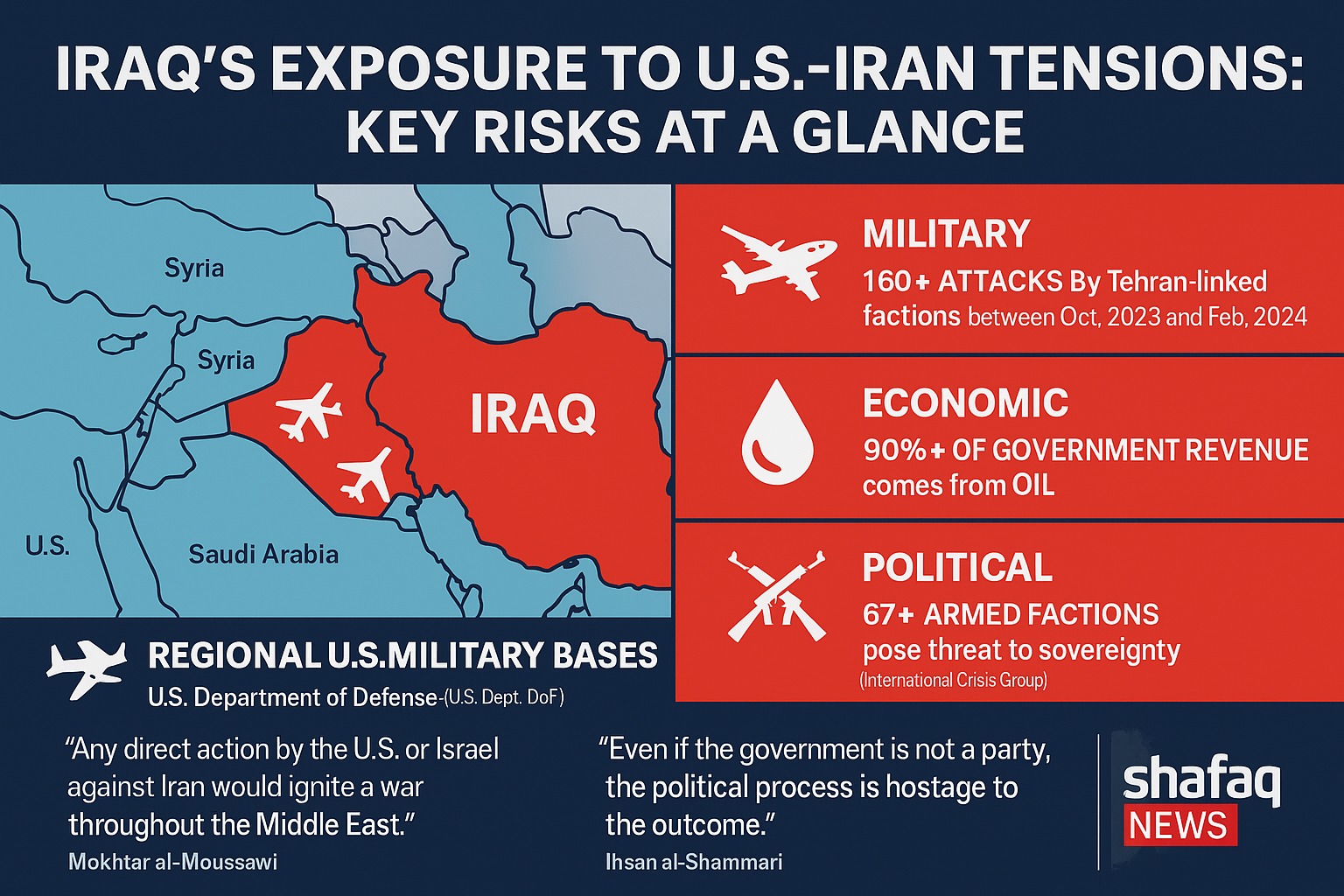
Economic Fallout and Political Fragmentation
The consequences of a US-Iran conflict would not be limited to military clashes. Iraq’s economy, heavily dependent on oil, would be among the first casualties. With more than 90% of government revenue derived from oil exports, any disruption in Basra or Kirkuk could cause a financial shock. Investor confidence, already fragile, would likely evaporate. International aid could stall, while inflation, displacement, and food insecurity would rise sharply. A 2023 World Bank report estimated that even a moderately intense regional war could slash up to 10% off Iraq’s GDP within a year.
Yet, perhaps more alarming than economic collapse is the threat of political fragmentation. Analysts warn that renewed war would empower the very armed groups the Iraqi state has long struggled to contain. In a climate of regional confrontation, Iran-aligned factions could exploit the chaos to gain both political and military leverage, pressing Baghdad into a more openly hostile posture toward Washington.
"The moment open war breaks out, Iraq’s neutrality collapses," cautioned political analyst Haydar al-Zaydi. "No matter what the government wants, the territory will be used, and the country will be branded a party to the conflict."
Al-Zaydi warned that such a shift would not only strain diplomatic ties with the United States but also deepen internal divisions. "Sunni provinces may seek distance from Shia-majority leadership if they feel war is being waged on their behalf. Kurdish regions, always wary of Baghdad’s entanglements, could accelerate moves toward autonomy," he observed. In effect, a regional war could reopen Iraq’s long-standing internal fault lines—territorial, ethnic, and sectarian.
Iraq’s security forces, meanwhile, would be tested far beyond their current capacity. While the Iraqi Army has made notable strides since the defeat of ISIS, it remains heavily reliant on foreign air support and intelligence, primarily from the US-led coalition. Should the US and Iran become direct combatants, this critical cooperation could unravel overnight, leaving Iraq exposed to both internal insurgency and external threats.
A Narrow Window for Peace
The implications of a breakdown in US-Iran negotiations, analysts warn, could extend far beyond Iraq, potentially engulfing the wider region in turmoil. Former Iraqi lawmaker Abdelhadi al-Saadawi cautioned that the fallout would likely reach "all countries hosting US military bases, including Kuwait, Qatar, Saudi Arabia, Syria, and others."
In remarks to Shafaq News, al-Saadawi warned of catastrophic consequences if diplomatic efforts fail. "A failure to reach an agreement could result in an environmental and humanitarian disaster," he said. "There is a real risk that ballistic missiles—possibly with nuclear warheads, as Israel claims Iran possesses—could be launched against Israel, US bases, and their allies."
Despite this grim scenario, al-Saadawi expressed cautious optimism that diplomacy may yet prevail. "Current signals from both Washington and Tehran suggest a trajectory toward de-escalation, which could yield significant positive outcomes for the region and the world," he added.