Shafaq News- Basra
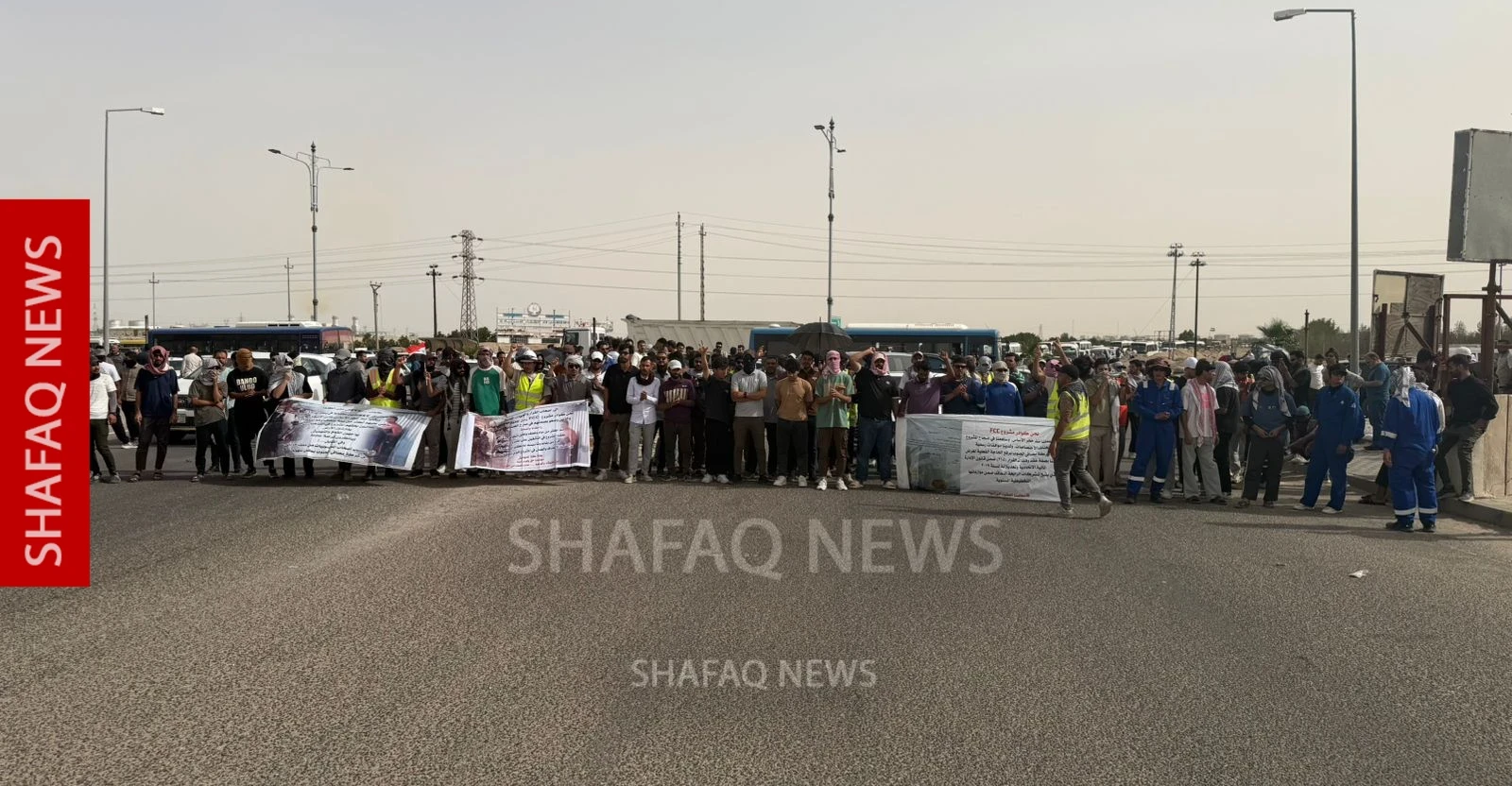
Former workers on Iraq’s FCC refinery project continued protests for a second consecutive day outside the South Refineries Company in Basra on Thursday, demanding employment and permanent positions within the Oil Ministry after helping build and operate a refinery project “central” to fuel self-sufficiency efforts.
Dozens of engineers, science graduates, and former FCC workers blocked the Al-Barijisya gate near Well 20. Protesters told Shafaq News that more than 350 former staff members had participated in constructing and operating the project over several years.
“We were surprised after the project became operational that we were dismissed without rights or job guarantees,” protest representative Ahmed Shaker said, adding that demonstrations had continued for more than a year and a half without official solutions.
“Several positions went to relatives and friends of officials,” he claimed, while experienced workers who had spent years inside the project were overlooked.
The Oil Ministry did not immediately comment on the protests.
Oil-rich southern provinces, particularly Basra, have witnessed recurring protests in recent years, with demonstrators frequently blocking roads leading to oil fields, refinery facilities, and ports over unemployment and poor living conditions despite the region’s vast energy wealth. Iraq’s unemployment rate stood at 15.5% in 2025, according to Trading Economics, while the Ministry of Labor and Social Affairs has reported 47,000 legally registered foreign workers in the country, even as more than one million Iraqis remain officially unemployed.
The Fluid Catalytic Cracking (FCC) project’s Japanese-funded complex, implemented by JGC Corporation through a concessional loan estimated at nearly $4 billion from the Japan International Cooperation Agency (JICA), officially entered operation on January 31, 2026, with a refining capacity of 55,000 barrels per day. During a 2025 visit to the site, Deputy Prime Minister for Energy Affairs and Oil Minister Hayan Abdul Ghani described the FCC complex as a “landmark step” toward reducing Iraq’s dependence on imported fuel products and achieving gasoline self-sufficiency, explaining that Iraq’s annual spending on imported petroleum products had previously exceeded $5 billion before refinery expansion projects sharply reduced imports.
Read more: Iraq’s protests after Tishreen: A system that learned how to contain the street