Shafaq News (Updated on May 03, at 20:00)
Four days before a constitutional deadline that could tip Iraq's government formation into legal crisis, the Shiite Coordination Framework —the largest bloc in the country's 329-seat parliament— has failed repeatedly to agree on a candidate for prime minister. The meetings were derailed by numbers that look decisive on paper and are paralyzed in practice.
The Framework holds 162 seats, nearly half of parliament, enough to claim the premiership designation under Iraq's post-2003 power-sharing system. Under that system, the prime minister is not elected by parliament but designated by whichever coalition can credibly claim the status of largest bloc, making the CF's internal selection process the real decision, and the subsequent parliamentary confidence vote its ratification.
In practice, those 162 seats are distributed across two internally competing power centers whose interests diverge sharply enough that no combination of arguments, incentives, or face-saving formulas has yet produced a majority willing to commit to a single name.
That ratification, however, is not guaranteed. A designated prime minister still requires the support of Sunni and Kurdish blocs to secure a parliamentary confidence vote. A candidate who arrives at that threshold without cross-community backing, regardless of how he was designated, cannot form a government. The internal CF contest and the broader parliamentary landscape are therefore inseparable, and the numbers across both arenas matter.
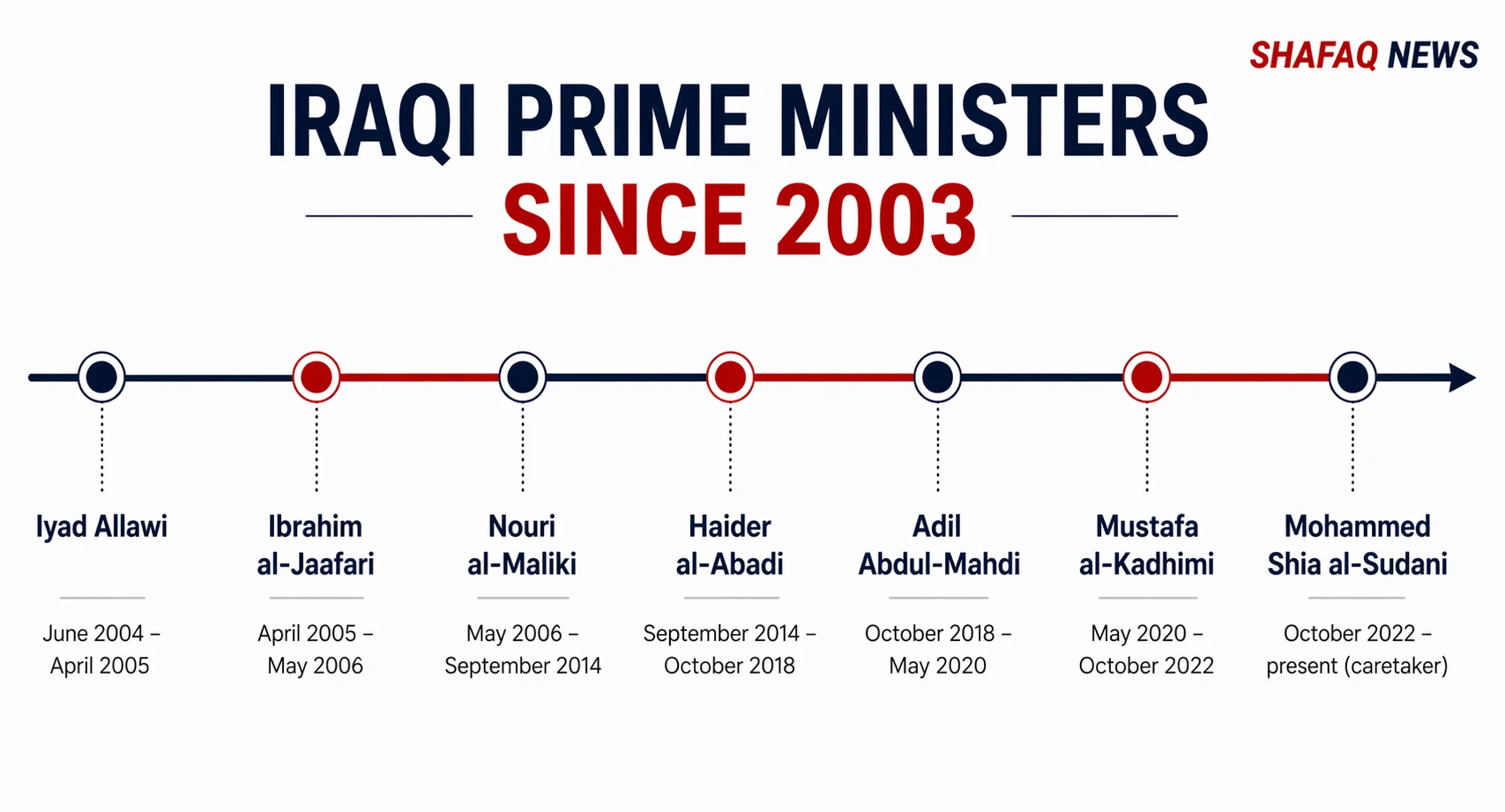
Under Article 76 of the Iraqi constitution, the Framework has until April 26 to formally present its nominee to President Nizar Amedi, who was elected by parliament on April 11. The nominee then has 30 days to form a government and secure parliamentary confidence. Each day the Framework spends in a failed session is a day subtracted from that window, and a signal to Iraq's partners, creditors, and regional neighbors that the caretaker government of Mohammed Shia al-Sudani may be managing the country's affairs for considerably longer than anyone formally acknowledges.
The 162-Seat Fiction
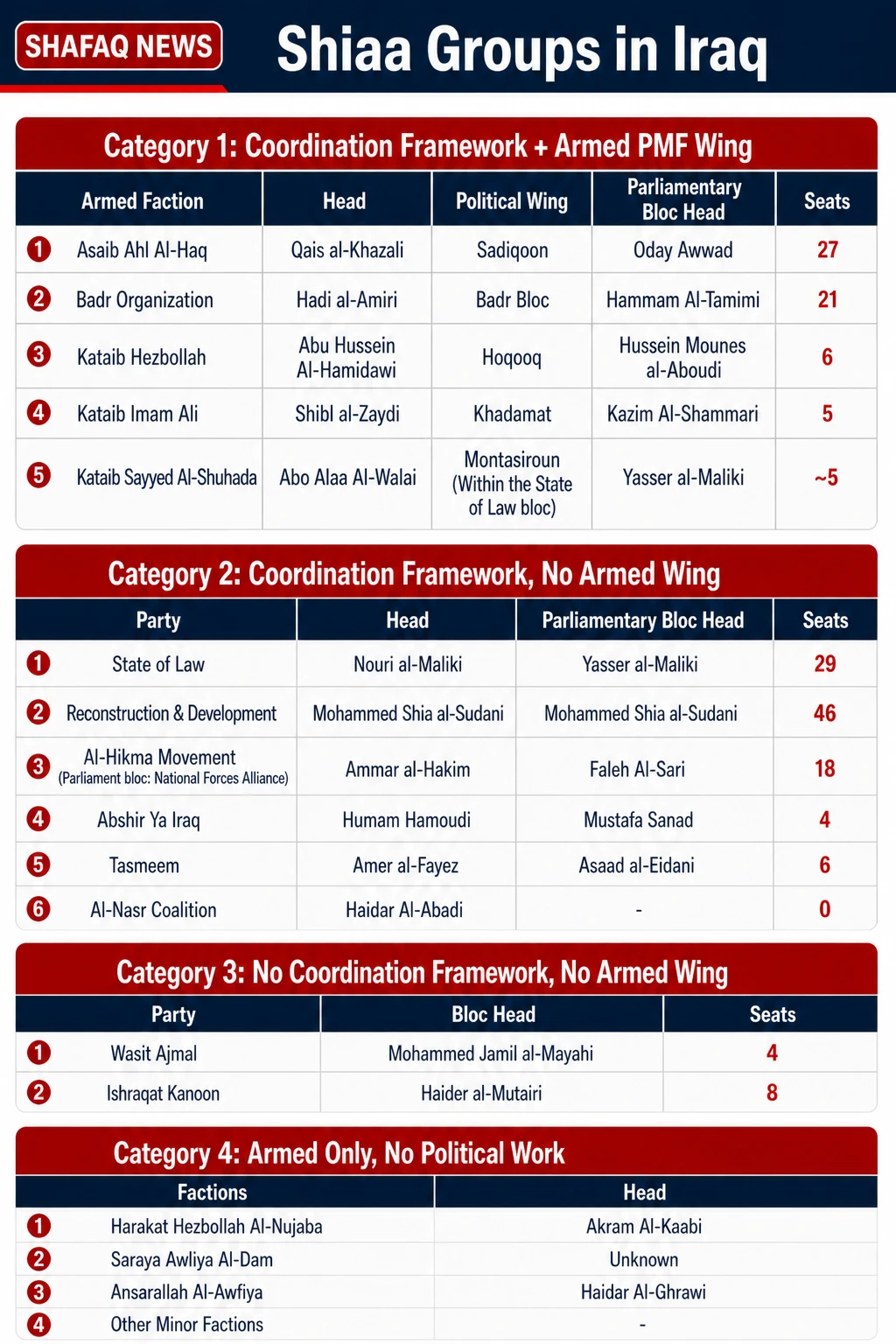
The Framework declared itself the largest parliamentary bloc following the November 2025 elections and claimed the premiership designation on that basis. The declaration was procedurally correct. What it obscured is that the 162 seats it claimed are not a unified political force, but an institutional label applied to two categories of parties whose common ground begins and ends with Shiite identity.
The first category, parties with active armed wings inside the Popular Mobilization Forces, accounts for 59 of those seats. Asaib Ahl al-Haq, the Iran-aligned paramilitary force that has since entered formal politics through its Sadiqoon movement, holds 27. The Badr Organization of Hadi al-Amiri holds 21. Kataib Hezbollah's political wing, Hoqooq, and Kataib Imam Ali's Khadamat movement add six and five, respectively. These blocs operate under a dual logic —parliamentary presence and armed capability— that gives them leverage inside the CF disproportionate to their seat count alone.
The second category, CF members without armed wings, holds the Framework's numerical majority at 103 seats. Caretaker Prime Minister Mohammed Shia al-Sudani's Reconstruction and Development coalition, the election's largest single winner with 46 seats, anchors this group. Nouri al-Maliki's State of Law coalition, which holds 29 seats and carries the Framework's formal nomination for the premiership, sits alongside Ammar al-Hakim's Al-Hikma Alliance with 18, and two smaller parties —Tasmeem and Abshir Ya Iraq— with six and four seats respectively.
The distinction between these two categories matters more than the CF's aggregate figure suggests. The “civilian majority” within the Framework is theoretically dominant. It is also the most fractured half, because civilian parties calculate in terms of governance costs, international legitimacy, and cabinet portfolios, while the armed-wing blocs calculate in terms of PMF autonomy and institutional control of the security sector.
Read more: Iraq’s next Prime Minister held hostage by US-Iran standoff
The Calculus Of Deadlock
The Framework formally nominated al-Maliki on January 24 by majority vote, not by the consensus that had governed previous nomination rounds. That procedural fracture signaled from the outset that his bid lacked the internal cohesion a confidence vote would eventually require.
Four days later, US President Donald Trump publicly rejected the nomination, threatening to cut Washington's support for Baghdad if al-Maliki returned to power. The American position hardened further when US Envoy Tom Barrack visited Baghdad and conveyed the objection through diplomatic channels directly to Iraqi political leaders.
Al-Maliki did not withdraw. His camp argued that the nomination was a collective CF decision rather than a personal ambition, and that any change of course must come from within the Framework itself. That framing —institutional loyalty as a shield against external pressure — has held his position in place even as the internal balance has shifted steadily against him.
The seat count tells the story with unusual clarity. Al-Maliki's committed coalition spans three communities but remains numerically modest: his own State of Law with 29 seats, Al-Azm alliance leader Muthanna al-Samarrai's Sunni bloc with 15, and the Kurdistan Democratic Party of Masoud Barzani with 26. The KDP welcomed his nomination publicly and concluded a reciprocal arrangement, even if not publicly, under which al-Maliki's forces would back the KDP's presidential candidate, Foreign Minister Fouad Hussein.
That arrangement collapsed on April 11 when parliament elected the Patriotic Union of Kurdistan's candidate Nizar Amedi as president, leaving the KDP without its side of the bargain and al-Maliki without his most significant non-Shiite backer.
The forces aligned against al-Maliki's personal bid command significantly greater parliamentary weight, even if they do not always agree on an alternative. Al-Sudani's Reconstruction and Development coalition holds 46 seats. The Sadiqoon movement of Qais al-Khazali and the Al-Hikma Alliance of Ammar al-Hakim, whose positions have converged around resistance to al-Maliki specifically, together contribute 45. Mohammed al-Halbousi's Taqadum party, the largest Sunni force with 33 seats, had already rejected al-Maliki's nomination before Trump's statement, grounding its opposition in domestic political rivalry rather than American pressure. The PUK's 15 seats, anchored by its April 11 presidential victory, sit firmly in the anti-al-Maliki camp.
Badr Organization leader Hadi al-Amiri's 21 seats remain formally neutral —the most consequential undeclared position in the entire negotiation.
The combined weight of forces either opposed to al-Maliki or uncommitted to him exceeds 160 seats across all communities. His committed base sits at roughly 70. The gap between those two figures is a structural verdict. What has kept al-Maliki's position alive is not numbers but leverage: his ability to deny the CF the internal consensus it needs to formally displace him, and the absence of a challenger whom all opposing factions can agree to support.
That absence has produced the current impasse. The Framework scheduled a decisive meeting for last Saturday, postponed it to Monday, and watched Monday's session end without resolution. Wednesday's attempt was similarly postponed to Friday, and April 26 is now four days away.
Read more: Iraq Government Formation: The Constitution that cannot enforce its own deadlines
The Mechanism Debate
Inside the failed sessions, two voting proposals have emerged as the Framework's attempt to break its own impasse, according to sources who spoke to Shafaq News.
The first would require any nominee to secure an absolute majority of CF members —a threshold of roughly 82 of 162 seats. Neither al-Maliki nor al-Sudani reaches that figure from his own bloc alone, making the outcome dependent on which man can pull Badr, Hoqooq, Khadamat, and the smaller parties into his column.
The second proposal links the selection to the parliamentary weight of blocs backing each contender, with the winning candidate required to surpass a two-thirds threshold within the Framework's leadership structure, equivalent to approximately 10 leadership votes. This shifts the contest from seat counts to institutional seniority, a terrain where al-Maliki's longer roots inside the CF machinery could offset his numerical disadvantage.
Both leaders have reportedly agreed that one of these mechanisms should govern the outcome. The agreement on process, however, masks a disagreement on proxy candidates that may prove equally difficult to resolve.
Al-Maliki's camp has advanced Bassem al-Badri, chair of the Accountability and Justice Commission, as a compromise figure. Al-Sudani's coalition has put forward Ihsan al-Awadi, director of the caretaker prime minister's office. Thirty lawmakers from al-Sudani's own bloc have threatened to withdraw their support if al-Awadi is nominated —a signal of the factional tension running even within what should be the Framework's dominant force.
Sources within the Framework told Shafaq News that if divisions persist, discussions may shift toward a third figure with political and administrative experience capable of addressing security, economic, and governance challenges while maintaining international acceptance. Caretaker Health Minister Saleh al-Hasnawi has been floated as one such name.
The PMF's institutional status has emerged as a parallel sticking point in the cabinet portfolio negotiations. Armed-wing blocs are demanding that the PMF's designation as an independent body be preserved in any government formation agreement, a condition that directly shapes Washington's assessment of the next prime minister's willingness to constrain Iranian-aligned forces.
The External Ceiling
What the internal CF sessions have not fully absorbed is that the room where the designation is nominally being made is not the only room where it is actually being decided.
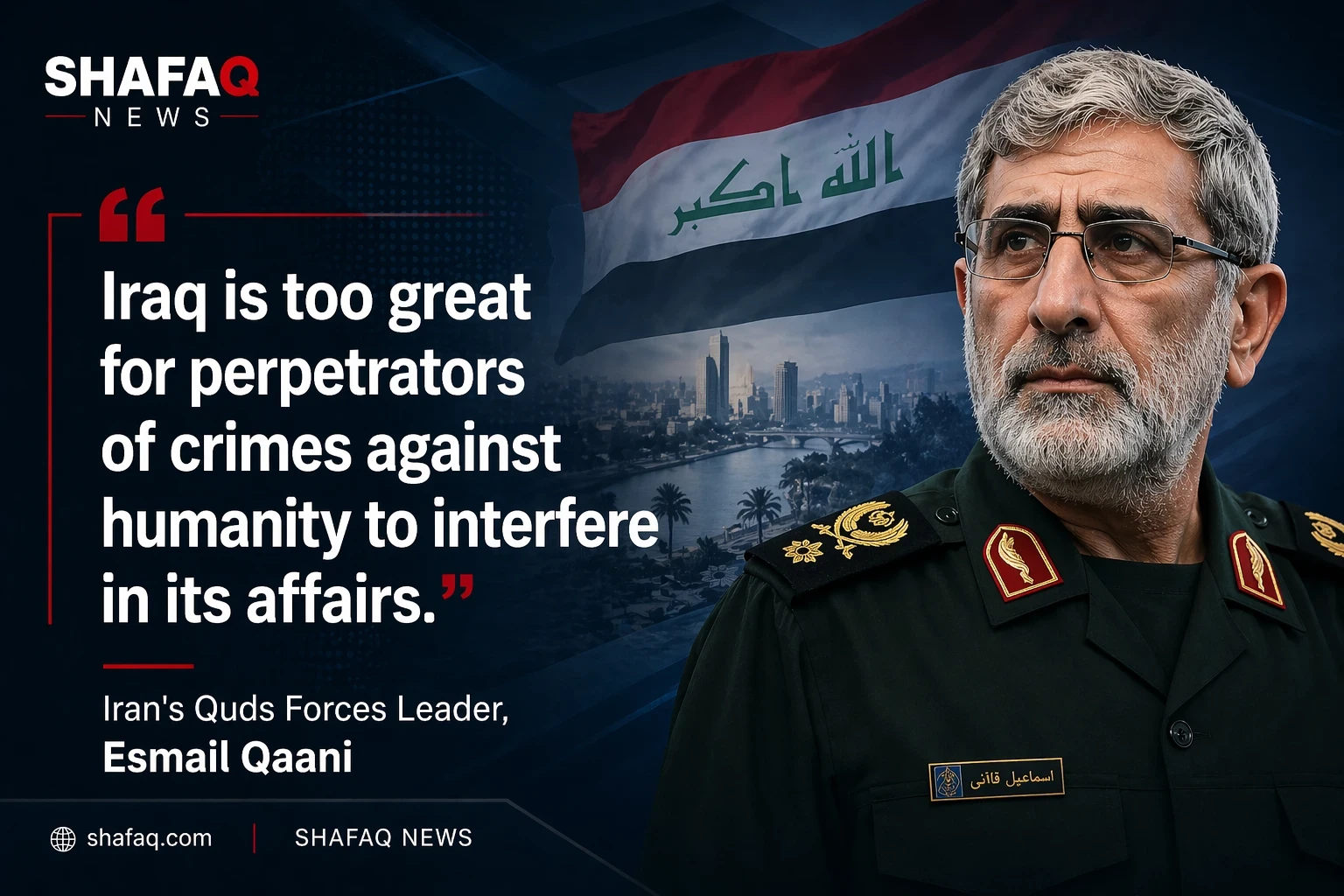
The commander of Iran's Quds Force, Esmail Qaani, completed a covert multi-day visit to Baghdad —his presence, as is customary, unannounced until after the fact. He departed, leaving his deputy behind to monitor two parallel files: the status of Iraqi armed groups in the event of an Iran-US agreement, and the government formation process itself. The dual mandate of that deputy's presence reflects Tehran's consistent position: the PM selection and the broader regional negotiation are not separate files.
In a message issued after his departure, Qaani stated that forming a government is "a purely Iraqi right," adding that "Iraq is too great for others to interfere in its affairs" —a formulation that pointedly referenced what he described as "perpetrators of crimes against humanity," understood as a reference to the United States. The statement publicly disavowed the very influence his presence was understood to be exercising. Most political observers in Baghdad read the visit itself as the signal, and the departing words as its diplomatic cover.
The consequences of that visit became visible shortly after. The CF was on the verge of naming al-Badri on Friday evening, with a Saturday session expected to confirm the choice. Subsequent developments —never formally identified by any party— unraveled an agreement that had appeared settled, sending the nine-candidate contest back to its starting point.
Washington's move is expected next. US Envoy Tom Barrack is anticipated to visit Baghdad imminently. The two visits —Qaani's concluded and Barrack's forthcoming— are the decisive external inputs that will shape Iraq's next political phase.
What The Numbers Cannot Resolve
The trajectory of the current negotiation points toward one of four outcomes, each carrying distinct consequences for Iraq's political architecture.
The first is an al-Maliki premiership. It remains constitutionally possible since he holds the CF's formal nomination, commands a committed cross-community coalition of roughly 70 seats, and has not withdrawn despite sustained internal and external pressure. His camp's strategy is not to win the internal CF numbers —he cannot— but to outlast the opposition's ability to coalesce around a single alternative.
Behind that strategy sits an implicit endorsement from Tehran, whose preference for al-Maliki as a known and institutionally reliable quantity has been visible throughout the formation process. However, what al-Maliki cannot overcome is the American, and the parliamentary confidence vote that follows any CF designation would require cross-community support that his current coalition cannot deliver. His 70-seat committed base falls critically short of the majority he would need, particularly given the public distance maintained by Sunni and Kurdish blocs that have either explicitly rejected his return or quietly withheld their backing.
The second is a second term for Al-Sudani, secured through the internal CF voting mechanism once al-Maliki's bid is formally exhausted. This is the outcome the seat distribution most clearly supports.
Al-Sudani commands the largest single bloc, enjoys tacit backing from al-Hakim and al-Khazali, faces no American veto, and demonstrated through his caretaker tenure a capacity to manage the competing pressures of Washington and Tehran without forcing either into open confrontation. He also carries the cross-community support that a confidence vote requires —the April 11 presidential session demonstrated that the coalition holds under pressure. A second Al-Sudani term would represent continuity dressed as resolution, the CF's nominal nominee displaced by its numerical reality.
The third is a compromise figure —al-Badri, al-Awadi, al-Hasnawi, or another name whose primary qualification is the absence of committed enemies. This outcome would resolve the immediate impasse while deferring its underlying causes. A prime minister without a political base of his own would govern through negotiated dependency on the blocs that installed him, meaning the CF's internal fracture would be managed rather than resolved.
External pressure shapes this scenario as directly as it does the others. Any compromise figure must clear two external thresholds simultaneously: Washington's acceptance, which rules out anyone perceived as an Iranian instrument, and Tehran's tolerance, which rules out anyone perceived as a reformist threat to PMF institutional autonomy.
The fourth, and constitutionally most precarious, outcome is a failure to meet the April 26 limit, forcing a legal and political reckoning over what happens when Iraq's largest bloc cannot exercise the designation it claims. The Federal Supreme Court's 2010 ruling on the largest bloc created the legal ground within which this contest is being fought. Whether that architecture contains a mechanism for resolving a CF impasse that crosses the constitutional threshold is a matter Iraqi legal scholars have not been required to address until now.
A bloc that cannot agree on a candidate across multiple failed sessions is not simply experiencing political friction. It is revealing, in real time, the limits of a power-sharing system designed to distribute influence rather than concentrate it, and that has never developed a mechanism for resolving the conflicts that distribution inevitably produces.
Read more: Iraq's Presidential vote:a rehearsal for premiership
Written and edited by Shafaq News staff.